

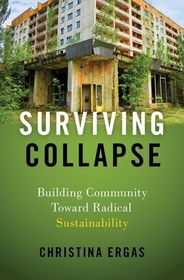
Surviving Collapse
Building Community toward Radical Sustainability
-
10% KEDVEZMÉNY?
- A kedvezmény csak az 'Értesítés a kedvenc témákról' hírlevelünk címzettjeinek rendeléseire érvényes.
- Kiadói listaár GBP 84.00
-
40 131 Ft (38 220 Ft + 5% áfa)
Az ár azért becsült, mert a rendelés pillanatában nem lehet pontosan tudni, hogy a beérkezéskor milyen lesz a forint árfolyama az adott termék eredeti devizájához képest. Ha a forint romlana, kissé többet, ha javulna, kissé kevesebbet kell majd fizetnie.
- Kedvezmény(ek) 10% (cc. 4 013 Ft off)
- Kedvezményes ár 36 118 Ft (34 398 Ft + 5% áfa)
Iratkozzon fel most és részesüljön kedvezőbb árainkból!
Feliratkozom
40 131 Ft

Beszerezhetőség
Megrendelésre a kiadó utánnyomja a könyvet. Rendelhető, de a szokásosnál kicsit lassabban érkezik meg.
Why don't you give exact delivery time?
A beszerzés időigényét az eddigi tapasztalatokra alapozva adjuk meg. Azért becsült, mert a terméket külföldről hozzuk be, így a kiadó kiszolgálásának pillanatnyi gyorsaságától is függ. A megadottnál gyorsabb és lassabb szállítás is elképzelhető, de mindent megteszünk, hogy Ön a lehető leghamarabb jusson hozzá a termékhez.
A termék adatai:
- Kiadó OUP USA
- Megjelenés dátuma 2023. május 9.
- ISBN 9780197544099
- Kötéstípus Keménykötés
- Terjedelem394 oldal
- Méret 147x229x22 mm
- Súly 567 g
- Nyelv angol 410
Kategóriák
Rövid leírás:
As environmental crises loom, Surviving Collapse makes an argument for radical changes in the ways in which people live to avoid a dystopian future. To foster readers' imagination, Christina Ergas reveals real utopian stories that counter climate apocalypse narratives. Two eco-communities offer examples of alternative futures with small environmental footprints and more egalitarian social practices. They model solutions to the interconnected problems of rising social inequalities and environmental degradation. Each case engages in community-oriented practices, direct democracy, and ecological agricultural forms that attend to whole ecosystems. These practitioners recognize the value of whole biotic communities, human and nonhuman, and practice reciprocity.
TöbbHosszú leírás:
As major environmental crises loom, Christina Ergas makes the argument in Surviving Collapse that one possible way forward is a radical sustainable development that turns the focus from monetary gain to social and ecological regeneration and transformation. Employing qualitative and cross-national comparative methods, Ergas examines two alternative, community-scale, socioecological models of development: the first is a grassroots urban ecovillage in the Pacific Northwest, United States, while the second is a government-subsidized, but cooperatively run, urban farm in Havana, Cuba. While neither are panaceas, they prioritize social and ecological efficiency and subsume economic rationality towards those ends. Featuring cases that not only allow us to synthesize their strengths but evaluate their weaknesses, Surviving Collapse reveals a multitude of varied paths toward reaching radical urban sustainability and empowers us all to imagine, and possibly build, more resilient futures.
Christina Ergas's book Surviving Collapse appears at a timely moment and represents a significant shift in the climate change discussion.
Tartalomjegyzék:
Preface
Acknowledgments
Introduction: Building Socioecological Community
Chapter 1: In the Shadow of Sustainable Development
Chapter 2: Grassroots Sustainability in a Concrete Landscape: An Urban Ecovillage in the Pacific Northwest
Chapter 3: Urban Oasis: Socioecological Sustainability in Cuban Urban Agriculture
Chapter 4: Beyond Neoliberalism: The Promise of a Communitarian Story
Chapter 5: Scaling Up the Values Themselves: Real Utopian Stories for the Climate Apocalypse
Conclusion: There Is No Future That Is Not Built in the Present
Appendix: Methods and Cases
Notes
References
Index

