

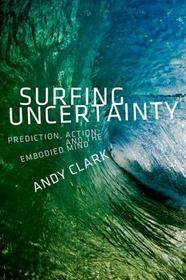
Surfing Uncertainty
Prediction, Action, and the Embodied Mind
-
10% KEDVEZMÉNY?
- A kedvezmény csak az 'Értesítés a kedvenc témákról' hírlevelünk címzettjeinek rendeléseire érvényes.
- Kiadói listaár GBP 33.99
-
15 346 Ft (14 615 Ft + 5% áfa)
Az ár azért becsült, mert a rendelés pillanatában nem lehet pontosan tudni, hogy a beérkezéskor milyen lesz a forint árfolyama az adott termék eredeti devizájához képest. Ha a forint romlana, kissé többet, ha javulna, kissé kevesebbet kell majd fizetnie.
- Kedvezmény(ek) 10% (kb. 1 535 Ft)
- Kedvezményes ár 13 811 Ft (13 154 Ft + 5% áfa)
Iratkozzon fel most és részesüljön kedvezőbb árainkból!
Feliratkozom
15 346 Ft

Beszerezhetőség
Megrendelésre a kiadó utánnyomja a könyvet. Rendelhető, de a szokásosnál kicsit lassabban érkezik meg.
Why don't you give exact delivery time?
A beszerzés időigényét az eddigi tapasztalatokra alapozva adjuk meg. Azért becsült, mert a terméket külföldről hozzuk be, így a kiadó kiszolgálásának pillanatnyi gyorsaságától is függ. A megadottnál gyorsabb és lassabb szállítás is elképzelhető, de mindent megteszünk, hogy Ön a lehető leghamarabb jusson hozzá a termékhez.
A termék adatai:
- Kiadó OUP USA
- Megjelenés dátuma 2016. január 7.
- ISBN 9780190217013
- Kötéstípus Keménykötés
- Terjedelem424 oldal
- Méret 236x155x30 mm
- Súly 703 g
- Nyelv angol
- Illusztrációk With illustrations 0
Kategóriák
Rövid leírás:
Exciting new theories in neuroscience, psychology, and artificial intelligence are revealing minds like ours as predictive minds, forever trying to guess the incoming streams of sensory stimulation before they arrive.
TöbbHosszú leírás:
In this ground-breaking work, philosopher and cognitive scientist Andy Clark turns a common view of the human mind upside down. In stark opposition to familiar models of human cognition, Surfing Uncertainty explores exciting new theories in neuroscience, psychology, and artificial intelligence that reveal minds like ours to be prediction machines--devices that have evolved to anticipate the incoming streams of sensory stimulation before they arrive. This keeps minds like ours a few steps ahead of the game, poised to respond rapidly and apparently effortlessly to threats and opportunities as (and sometimes even before) they arise.
Creatures thus equipped are more than simple response machines. They are knowing agents deep in the business of understanding their worlds. Such agents cope with changing and uncertain worlds by combining sensory evidence with informed prediction. Remarkably, the learning that makes neural prediction possible can itself be accomplished by the ceaseless effort to make better and better predictions. A single fundamental trick (the trick of trying to predict your own sensory inputs) thus enables learning, empowers moment-by-moment perception, and installs a rich understanding of the surrounding world.
Action itself now appears in a new and revealing light. For action is not so much a 'response to an input' as a neat and efficient way of selecting the next 'input'. As mobile embodied agents we are forever intervening, actively bringing about the very streams of sensory information that our brains are simultaneously trying to predict. This binds perception and action in a delicate dance, a virtuous circle in which neural circuits animate, and are animated by, the movements of our own bodies. Some of our actions, in turn, structure the physical, social, and technological worlds around us. This moves the goalposts by altering the very things we need to engage and predict.
Surfing Uncertainty brings work on the predictive brain into full and satisfying contact with work on the embodied and culturally situated mind. What emerges is a bold new vision of what brains do that places circular causal flows and the active structuring of the environment, center-stage. In place of cognitive couch potatoes idly awaiting the next sensory inputs, Clark's journey reveals us as proactive predictavores, skilfully surfing the waves of sensory stimulation.
The book admirably conveys the excitement and ambition of the field ... Andy Clark has given us stimulating reasons for applying the predictive processing models to new domains.
Tartalomjegyzék:
Table of Contents
Preface: Meat That Predicts
Acknowledgements
Introduction: Guessing Games
Part I: The Power of Prediction
Chapter 1: Prediction Machines
1.1 Two Ways to Sense the Coffee
1.2 Adopting the Animal's Perspective
1.3 Learning in Bootstrap Heaven
1.4 Multi-Level Learning
1.5 Decoding Digits
1.6 Dealing With Structure
1.7 Predictive Processing
1.8 Signaling the News
1.9 Predicting Natural Scenes
1.10 Binocular Rivalry
1.11 Dampening and Sharpening
1.12 Encoding, inference, and the Bayesian Brain
1.13 Getting the Gist
1.14 Predictive Processing in the Brain
1.15 Is Silence Golden?
1.16 Expecting Faces
1.17 When Prediction Misleads
1.18 Mind Turned Upside Down
Chapter Two: Adjusting The Volume (Noise, Signal, Attention)
2.1 Signal Spotting
2.2 Hearing Bing
2.3 The Delicate Dance between Top-down and Bottom-up.
2.4 Attention, Biased Competition, and Signal Enhancement
2.5 Sensory Integration and Coupling
2.6 A Taste of Action
2.7 Gaze Allocation: Doing What Comes Naturally
2.8 Circular Causation in the Perception-Attention-Action Loop
2.9 Mutual Assured Misunderstanding
2.10 Some Worries About Precision
2.11 The Unexpected Elephant
2.12 Some Pathologies of Precision
2.13 Beyond the Spotlight
Chapter 3: The Imaginarium
3.1 The Many Benefits of Controlled Hallucination
3.2 Simple Seeing
3.3 Cross-Modal and Multi-Modal effects
3.4 Meta-Modal Effects
3.5 Perceiving Omissions
3.6 Expectations and Conscious Perception
3.7 The Perceiver as Imaginer
3.8 'Brain Reading' During Imagery and Perception
3.9 Inside the Dream Factory
3.10 PIMMS and the Past
3.11 Towards Mental Time Travel
3.12 A Cognitive Package Deal
Part II: Embodying Prediction
Chapter 4: Prediction for Action
4.1 Staying Ahead of the Break
4.2 Ticklish Tales
4.3 Forward Models
4.4 Optimal Feedback Control
4.5 Action-oriented Predictive Processing
4.6 Simplifying Control
4.7 Beyond Efference Copy
4.7 Doing Without Cost Functions
4.8 Action-oriented Predictions
4.9 Predictive Robotics
4.10 Perception-Action-Understanding Machines
Chapter 5: Sculpting the Flow
5.1 Double Agents
5.2 Towards Maximal Context-Sensitivity
5.3 Hierarchy Reconsidered
5.4 Sculpting Effective Connectivity
5.5 Soft Modularity
5.6 Understanding Action
5.7 Making Mirrors
5.8 Whodunit?
5.9 Robot Futures
5.10 The Restless, Rapidly Responsive, Brain
5.11 Precision Engineering
Chapter 6: Engaging the world
6.1 Expecting the World
6.2 Controlled Hallucinations and Virtual Realities.
6.3 The Surprising Scope of Structured Probabilistic Learning
6.4 Sensing-Thinking-Acting
6. 5 Implementing Affordance Competition
6.6 Ready for Action
6.7 Hello World
6.8 'Not-Indirect' Perception
6.9 Hallucination as Uncontrolled Perception
6.10 Putting Illusions in Their Place
6.11 Safer Penetration
6.12 Who Estimates the Estimators?
6.13 Beyond Fantasy
Chapter 7: Expecting Ourselves
7.1 The Space of Human Experience
7.2 Warning Lights
7.3 The Spiral of Inference and Experience
7.4 Schizophrenia and Smooth Pursuit Eye Movements
7.5 Simulating Smooth Pursuit
7.6 Disturbing the Network (Smooth Pursuit)
7.7 Tickling Redux
7.8 Less Sense, More Action
7.9 Disturbing the Network (Sensory Attenuation)
7.10 'Psychogenic Disorders' and Placebo Effects
7.11 Disturbing the Network ('Psychogenic' Effects)
7.12 Autism, Noise, and Signal
7.13 Conscious Presence
7.14 Emotion
7.15 Fear in the Night
7.16 A Nip of the Hard Stuff
Part III: Scaffolding Prediction
Chapter 8: The Lazy Predictive Brain
8.1 Surface Tensions
8.2 Productive Laziness
8.3 Ecological Balance, and Baseball
8.4 Embodied Flow
8.5 Befriending the Bayesian Brain
8.6 Beyond the Model-Based/Model-Free Divide
8.7 Balancing Accuracy and Complexity
8.8.Back to Baseball
8.9 Extended Predictive Minds
8.10 Escape from the Darkened Room
8.11 Self-Organized Instability
8.12 Fast, Cheap, but Model-Rich Too
Chapter 9: Being Human
9.1 Putting Prediction in its Place
9.2 Reprise: Self-Organizing Around Prediction Error
9.3 Efficiency and " The Lord's Prior "
9.4 Chaos and Spontaneous Cortical Activity
9.5 Designer Environments
9.6 White Lines
9.7 Innovating for Innovation
9.8 Words as Artificial Contexts
9.9 Predicting With Others
9.10 Enacting Our Worlds
9.11 Representations: Breaking Good
9.12 Prediction in the Wild
Chapter 10: The Future of Prediction
10.1 Attractions
10.2 Problems, Puzzles, and Pitfalls
Appendix 1: Bare Bayes
Appendix 2: The Free Energy Formulation
References
Index

