

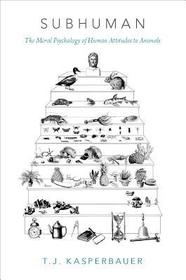
Subhuman
The Moral Psychology of Human Attitudes to Animals
-
10% KEDVEZMÉNY?
- A kedvezmény csak az 'Értesítés a kedvenc témákról' hírlevelünk címzettjeinek rendeléseire érvényes.
- Kiadói listaár GBP 42.49
-
19 184 Ft (18 270 Ft + 5% áfa)
Az ár azért becsült, mert a rendelés pillanatában nem lehet pontosan tudni, hogy a beérkezéskor milyen lesz a forint árfolyama az adott termék eredeti devizájához képest. Ha a forint romlana, kissé többet, ha javulna, kissé kevesebbet kell majd fizetnie.
- Kedvezmény(ek) 10% (kb. 1 919 Ft)
- Kedvezményes ár 17 265 Ft (16 443 Ft + 5% áfa)
Iratkozzon fel most és részesüljön kedvezőbb árainkból!
Feliratkozom
19 184 Ft

Beszerezhetőség
Megrendelésre a kiadó utánnyomja a könyvet. Rendelhető, de a szokásosnál kicsit lassabban érkezik meg.
Why don't you give exact delivery time?
A beszerzés időigényét az eddigi tapasztalatokra alapozva adjuk meg. Azért becsült, mert a terméket külföldről hozzuk be, így a kiadó kiszolgálásának pillanatnyi gyorsaságától is függ. A megadottnál gyorsabb és lassabb szállítás is elképzelhető, de mindent megteszünk, hogy Ön a lehető leghamarabb jusson hozzá a termékhez.
A termék adatai:
- Kiadó OUP USA
- Megjelenés dátuma 2018. február 8.
- ISBN 9780190695811
- Kötéstípus Keménykötés
- Terjedelem248 oldal
- Méret 145x211x22 mm
- Súly 295 g
- Nyelv angol 0
Kategóriák
Rövid leírás:
How do we think about animals? How do we decide what they deserve and how we ought to treat them? Subhuman takes an interdisciplinary approach to these questions, drawing from research in philosophy, neuroscience, psychology, law, history, sociology, economics, and anthropology. Subhuman argues that our attitudes to nonhuman animals, both positive and negative, largely arise from our need to compare ourselves to them.
TöbbHosszú leírás:
When Harambe, a now-famous gorilla at the Cincinnati zoo, was shot for endangering a small child, animal rights activists protested, calling into question moral reasoning that privileges the possibility of injury to a human over definite violence to an animal. Many others, though less vehement in their objection, voiced the same questions: was the gorilla any worse than the negligent parents? Doesn't Harambe have rights just like you and me?
How do we decide what animals deserve and how we ought to treat them? To what extent are our attitudes towards animals embedded in our subconscious and immune to reason? The foundations of our moral attitudes to animals are more complex than many may appreciate. Subhuman takes an interdisciplinary approach to these questions, drawing from research in philosophy, neuroscience, psychology, law, history, sociology, economics, and anthropology, to unearth surprising revelations about human relationships with animals. T.J. Kasperbauer argues provocatively that behind our positive and negative attitudes to animals is an enduring concern that animals pose a threat to our humanness. Namely, our need to ensure animals' inferiority to human beings affects both our kindness and cruelty to animals. Kasperbauer develops this idea by looking at research on the phenomenon of dehumanization, revealing that our attitudes to other humans are predicted and reflected in our treatment of other species.
In making his case, Kasperbauer provides a critical survey of leading theories that range over the role of animals in human evolutionary history, the psychology of meat-eating and keeping pets, feelings of fear and disgust toward animals, the use of animal minds to determine their moral status, and the "expanding moral circle" hypothesis. By exploring the psychological obstacles humans face in meeting ethical demands, Kasperbauer sets forth new and fascinating ways of thinking about our moral obligations to animals, and how we might correct them.
...offers a helpful critique...
Tartalomjegyzék:
1. Introduction
2. Evolved Attitudes to Animals
3. Dehumanizing Animals
4. Dehumanization and Mentalizing Animals
5. Diagnosing Moral Failures
6. Psychological Plausibility for Animal Ethics
7. Animals and the Expanding Moral Circle
8. Managing Moral Psychology for Animal Ethics
Acknowledgements
References

