

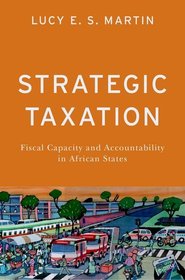
Strategic Taxation
Fiscal Capacity and Accountability in African States
-
10% KEDVEZMÉNY?
- A kedvezmény csak az 'Értesítés a kedvenc témákról' hírlevelünk címzettjeinek rendeléseire érvényes.
- Kiadói listaár GBP 72.00
-
32 508 Ft (30 960 Ft + 5% áfa)
Az ár azért becsült, mert a rendelés pillanatában nem lehet pontosan tudni, hogy a beérkezéskor milyen lesz a forint árfolyama az adott termék eredeti devizájához képest. Ha a forint romlana, kissé többet, ha javulna, kissé kevesebbet kell majd fizetnie.
- Kedvezmény(ek) 10% (kb. 3 251 Ft)
- Kedvezményes ár 29 257 Ft (27 864 Ft + 5% áfa)
Iratkozzon fel most és részesüljön kedvezőbb árainkból!
Feliratkozom
32 508 Ft

Beszerezhetőség
Megrendelésre a kiadó utánnyomja a könyvet. Rendelhető, de a szokásosnál kicsit lassabban érkezik meg.
Why don't you give exact delivery time?
A beszerzés időigényét az eddigi tapasztalatokra alapozva adjuk meg. Azért becsült, mert a terméket külföldről hozzuk be, így a kiadó kiszolgálásának pillanatnyi gyorsaságától is függ. A megadottnál gyorsabb és lassabb szállítás is elképzelhető, de mindent megteszünk, hogy Ön a lehető leghamarabb jusson hozzá a termékhez.
A termék adatai:
- Kiadó OUP USA
- Megjelenés dátuma 2023. november 21.
- ISBN 9780197672631
- Kötéstípus Keménykötés
- Terjedelem232 oldal
- Méret 235x156x18 mm
- Súly 463 g
- Nyelv angol
- Illusztrációk 9 graphs 439
Kategóriák
Rövid leírás:
This book explains how and when developing countries will increase taxation to fund state development. Taxation fundamentally changes the relationship between governments and citizens, leading citizens to increase the demands they place on government. While this can lead governments to decrease corruption and increase public goods, it can also lead governments to strategically underinvest in state capacity and to lower taxation in order to reduce citizens' demands. The book shows that low-capacity democracies are particularly prone to low taxation.
TöbbHosszú leírás:
Across the developing world, governments still lack the fiscal capacity to fund critical public goods, alleviate poverty, and invest in economic development. Yet, we know little about how to effectively build strong states in these settings. This book develops and tests a new theory to explain why fiscal capacity in African states is low. Drawing on work in psychology and behavioral economics, this book argues that taxation leads citizens to demand more from leaders as they seek to recover lost income from taxation. It then argues that governments' willingness to tax will depend on the extent to which they can satisfy citizens' demands while maintaining rent extraction. Rent-seeking leaders of low-capacity states will strategically underinvest in fiscal capacity in order to avoid the higher demands they face under taxation. Contrary to many existing theories, Martin shows that this can actually lead to lower taxation in democracies compared to autocracies, as citizen accountability demands pose a bigger threat to rulers.
The book uses multiple empirical approaches to test the theory. Laboratory experiments in Uganda and Ghana, combined with Afrobarometer data, demonstrate that taxation increases citizens' demands on leaders. Global cross-national panel data show that democracy can actually lead to lower taxation in low-capacity states. When taxation is sustainable, however, it is associated with better governance. Case studies in Uganda, based on the author's own fieldwork and original survey data, provide additional support for the theory. These findings provide new framework for understanding the challenges to building state capacity, especially fiscal capacity, in modern developing countries.
Strategic taxation sheds light on the challenges low-capacity democracies face in balancing tax-based accountability with their institutional limitations. It contributes to a growing body of literature exploring the political economy of taxation and to our understanding of how fiscal capacity and democratic pressures intersect. The book offers a theoretical foundation upon which tofurther explore the real-world and long-term impacts of taxation on citizen behaviour and the core question of how to overcome political disincentives to tax and break the low-tax, low-capacity vicious cycle.
Tartalomjegyzék:
1. Introduction
2. Understanding Fiscal Capacity
3. How Taxation Increases Accountability Demands
Appendix
4. A Model of Taxation and Accountability
5. Evidence that Taxation Increases Accountability Demands
6. Taxation, Democracy, and Accountability
7. Understanding Taxation in Uganda
8. Conclusion

