

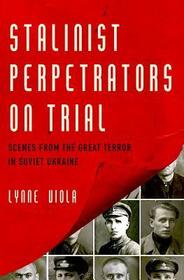
Stalinist Perpetrators on Trial
Scenes from the Great Terror in Soviet Ukraine
-
10% KEDVEZMÉNY?
- A kedvezmény csak az 'Értesítés a kedvenc témákról' hírlevelünk címzettjeinek rendeléseire érvényes.
- Kiadói listaár GBP 25.99
-
11 734 Ft (11 175 Ft + 5% áfa)
Az ár azért becsült, mert a rendelés pillanatában nem lehet pontosan tudni, hogy a beérkezéskor milyen lesz a forint árfolyama az adott termék eredeti devizájához képest. Ha a forint romlana, kissé többet, ha javulna, kissé kevesebbet kell majd fizetnie.
- Kedvezmény(ek) 10% (cc. 1 173 Ft off)
- Kedvezményes ár 10 560 Ft (10 058 Ft + 5% áfa)
Iratkozzon fel most és részesüljön kedvezőbb árainkból!
Feliratkozom
11 734 Ft

Beszerezhetőség
Megrendelésre a kiadó utánnyomja a könyvet. Rendelhető, de a szokásosnál kicsit lassabban érkezik meg.
Why don't you give exact delivery time?
A beszerzés időigényét az eddigi tapasztalatokra alapozva adjuk meg. Azért becsült, mert a terméket külföldről hozzuk be, így a kiadó kiszolgálásának pillanatnyi gyorsaságától is függ. A megadottnál gyorsabb és lassabb szállítás is elképzelhető, de mindent megteszünk, hogy Ön a lehető leghamarabb jusson hozzá a termékhez.
A termék adatai:
- Kiadó OUP USA
- Megjelenés dátuma 2018. január 25.
- ISBN 9780190674168
- Kötéstípus Keménykötés
- Terjedelem304 oldal
- Méret 236x163x25 mm
- Súly 567 g
- Nyelv angol
- Illusztrációk 19 illus. 0
Kategóriák
Rövid leírás:
An inside account of the trials and punishments of the Soviet secret police officers who carried out the Great Terror, this book uses the criminal files from Ukraine to take readers inside the operations of the interrogation rooms and execution chambers where Stalin's regime enacted state violence.
TöbbHosszú leírás:
Between the summer of 1937 and November 1938, the Stalinist regime arrested over 1.5 million people for "counterrevolutionary" and "anti-Soviet" activity and either summarily executed or exiled them to the Gulag. While we now know a great deal about the experience of victims of the Great Terror, we know almost nothing about the lower- and middle-level Narodnyi Komissariat Vnutrennikh Del (NKVD), or secret police, cadres who carried out Stalin's murderous policies. Unlike the postwar, public trials of Nazi war criminals, NKVD operatives were tried secretly. And what exactly happened in those courtrooms was unknown until now.
In what has been dubbed "the purge of the purgers," almost one thousand NKVD officers were prosecuted by Soviet military courts. Scapegoated for violating Soviet law, they were charged with multiple counts of fabrication of evidence, falsification of interrogation protocols, use of torture to secure "confessions," and murder during pre-trial detention of "suspects" - and many were sentenced to execution themselves. The documentation generated by these trials, including verbatim interrogation records and written confessions signed by perpetrators; testimony by victims, witnesses, and experts; and transcripts of court sessions, provides a glimpse behind the curtains of the terror. It depicts how the terror was implemented, what happened, and who was responsible, demonstrating that orders from above worked in conjunction with a series of situational factors to shape the contours of state violence.
Based on chilling and revelatory new archival documents from the Ukrainian secret police archives, Stalinist Perpetrators on Trial illuminates the darkest recesses of Soviet repression -- the interrogation room, the prison cell, and the place of execution -- and sheds new light on those who carried out the Great Terror.
Much detail on how NKVD leaders and rank-and-file interrogators behaved during the height of the terror appears here for the first time, and Viola has expanded our knowledge of how the mass repressions worked.
Tartalomjegyzék:
Chronology
A Note on Usage
Glossary
Introduction
Ch 1: The Incomplete Civil War and the Great Terror
Ch 2: A Taste for Terror
Ch 3: Vania the Terrible
Ch 4: Under the Dictation of Fleishman
Ch 5: What Happened in Uman?
Ch 6: An Excursion to Zaporozh'e
Ch 7: Upsenskii's Stooge
Postscript
Conclusion
Acknowledgments
Notes
Bibliography
Index

