

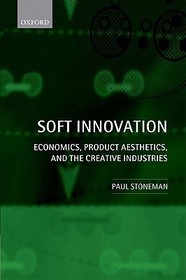
Soft Innovation
Economics, Product Aesthetics, and the Creative Industries
-
10% KEDVEZMÉNY?
- A kedvezmény csak az 'Értesítés a kedvenc témákról' hírlevelünk címzettjeinek rendeléseire érvényes.
- Kiadói listaár GBP 53.00
-
23 929 Ft (22 790 Ft + 5% áfa)
Az ár azért becsült, mert a rendelés pillanatában nem lehet pontosan tudni, hogy a beérkezéskor milyen lesz a forint árfolyama az adott termék eredeti devizájához képest. Ha a forint romlana, kissé többet, ha javulna, kissé kevesebbet kell majd fizetnie.
- Kedvezmény(ek) 10% (cc. 2 393 Ft off)
- Kedvezményes ár 21 537 Ft (20 511 Ft + 5% áfa)
Iratkozzon fel most és részesüljön kedvezőbb árainkból!
Feliratkozom
23 929 Ft

Beszerezhetőség
Megrendelésre a kiadó utánnyomja a könyvet. Rendelhető, de a szokásosnál kicsit lassabban érkezik meg.
Why don't you give exact delivery time?
A beszerzés időigényét az eddigi tapasztalatokra alapozva adjuk meg. Azért becsült, mert a terméket külföldről hozzuk be, így a kiadó kiszolgálásának pillanatnyi gyorsaságától is függ. A megadottnál gyorsabb és lassabb szállítás is elképzelhető, de mindent megteszünk, hogy Ön a lehető leghamarabb jusson hozzá a termékhez.
A termék adatai:
- Kiadó OUP Oxford
- Megjelenés dátuma 2011. augusztus 4.
- ISBN 9780199697021
- Kötéstípus Puhakötés
- Terjedelem382 oldal
- Méret 234x170x22 mm
- Súly 602 g
- Nyelv angol 0
Kategóriák
Rövid leírás:
Much of the existing economic literature on innovation has taken a particularly functional viewpoint as to what innovation might be. This book explores 'soft innovation', found in the creative industries such as publishing, film-making, advertising, and architecture, which has been, hitherto, ignored in innovation studies.
TöbbHosszú leírás:
At its heart this book is about innovation and the innovation process. On the way, it considers aesthetics, design, creativity and the creative industries, and a number of other similar topics.
Much of the existing economic literature on innovation has taken a particularly technological or functional viewpoint as to what sort of new products and processes are to be considered innovations. One of the key points that this book highlights is that there is a type of innovation, here labelled 'soft innovation', primarily concerned with changes in products (and perhaps processes) of an aesthetic or intellectual nature, that has largely been ignored in the study of innovation prevalent in economics. Examples of innovations that, as a result of this refocusing, are here placed at the centre of the analysis include: the writing and publishing of a new book, the writing, production, and launching of a new movie, the development and launch of a new advertising promotion, the design and production of a new range of furniture, and architectural activity in the generation of new built form designs. The realisation of the existence of soft innovation means that, not only is innovation more widespread than previously considered, but that it may also take a different form than commonly considered.
Soft Innovation addresses key issues such as:
* The measurement of the rate and extent of soft innovation,
* The determinants of the rate and direction of soft innovation and its diffusion,
* The impacts of soft innovation and diffusion upon outputs, productivity, employment, firm performance, trade, and economic welfare,
* Policy, considering whether there is a rationale for government intervention in the soft innovation generation and diffusion processes, and if so what instruments can be used in such intervention?
Soft Innovation breaks new ground in the study of innovation, and will be key reading for academics and researchers of Innovation, Marketing, and Design, as well as consultants, practitioners, and policy-makers concerned with the creative industries.
a major work of scholarship in a critical field of industry and policy.
Tartalomjegyzék:
Introduction
Part I: The Nature and Extent of Soft Innovation
Defining Soft Innovation
Aggregate Measures of Soft Innovation
Soft Innovation in the Creative Industries: Books, Recorded Music, and Video Games
Soft Innovations Outside the Creative Industries: The Food, Pharmaceuticals, and Financial Industries
Part II: The Economic Analysis of Soft Innovation
The Economic Analysis of TPP Innovation as a Foundation for the Analysis of Soft Innovation
The Supply of Soft Product Innovations
The Diffusion of Soft Innovations
Soft Innovation and Uncertainty: Variant Proliferation, Insurance Markets, and Finance
Soft Innovation, Intellectual Property Rights, Competition, and Welfare
Part III: Impacts and Implications
The Impact of Soft Innovations on Firm Performance
Soft Innovation and Government Policy
Conclusions and Future Prospects

