

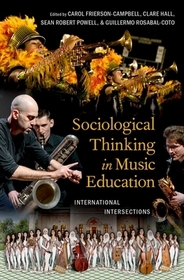
Sociological Thinking in Music Education
International Intersections
-
10% KEDVEZMÉNY?
- A kedvezmény csak az 'Értesítés a kedvenc témákról' hírlevelünk címzettjeinek rendeléseire érvényes.
- Kiadói listaár GBP 98.00
-
46 819 Ft (44 590 Ft + 5% áfa)
Az ár azért becsült, mert a rendelés pillanatában nem lehet pontosan tudni, hogy a beérkezéskor milyen lesz a forint árfolyama az adott termék eredeti devizájához képest. Ha a forint romlana, kissé többet, ha javulna, kissé kevesebbet kell majd fizetnie.
- Kedvezmény(ek) 10% (cc. 4 682 Ft off)
- Kedvezményes ár 42 138 Ft (40 131 Ft + 5% áfa)
Iratkozzon fel most és részesüljön kedvezőbb árainkból!
Feliratkozom
46 819 Ft

Beszerezhetőség
Becsült beszerzési idő: A Prosperónál jelenleg nincsen raktáron, de a kiadónál igen. Beszerzés kb. 3-5 hét..
A Prosperónál jelenleg nincsen raktáron.
Why don't you give exact delivery time?
A beszerzés időigényét az eddigi tapasztalatokra alapozva adjuk meg. Azért becsült, mert a terméket külföldről hozzuk be, így a kiadó kiszolgálásának pillanatnyi gyorsaságától is függ. A megadottnál gyorsabb és lassabb szállítás is elképzelhető, de mindent megteszünk, hogy Ön a lehető leghamarabb jusson hozzá a termékhez.
A termék adatai:
- Kiadó OUP USA
- Megjelenés dátuma 2022. április 28.
- ISBN 9780197600962
- Kötéstípus Keménykötés
- Terjedelem288 oldal
- Méret 168x251x27 mm
- Súly 567 g
- Nyelv angol
- Illusztrációk 5 illustrations 207
Kategóriák
Rövid leírás:
Sociological Thinking in Music Education presents new ideas about music teaching and learning as important social, political, economic, ecological, and cultural ways of being, with an overarching aim to move beyond mere descriptions of what is by analyzing how social inequalities and inequities, conflict and control, and power can be understood in and through music teaching and learning at both individual and collective levels.
TöbbHosszú leírás:
Sociological Thinking in Music Education presents new ideas about music teaching and learning as important social, political, economic, ecological, and cultural ways of being. At the book's heart is the intersection between theory and practice where readers gain glimpses of intriguing social phenomena as lived through music learning and teaching. The vital roles played by music and music education in various societies around the world are illustrated through pivotal intersections between music education and sociology: community, schooling, and issues of decolonization.
In this book, emerging as well as established scholars mobilize the links between applied sociology, music, education, and music education in ways that intersect the scholarly and the personal. These interdisciplinary vantage points fulfil the book's overarching aim to move beyond mere descriptions of what is, by analyzing how social inequalities and inequities, conflict and control, and power can be understood in and through music teaching and learning at both individual and collective levels. The result is not only encountering new ideas regarding the social construction of music education practices in specific places, but also seeing and hearing familiar ones in fresh ways. Digital assets enable readers to meet the authors and the points of their inquiry via various audiovisual media, including videos, a documentary music film, and multi-lingual video précis for each chapter in English as well as in each author's language of origin.
Just looking through the extraordinarily diverse bibliography made me want to delve straight inside this book! Sure enough, it contains an exhilarating collection of perspectives and insights pertaining to many parts of the world and many aspects of the sociology of music education. Highly recommended for both seasoned scholars and those new to the field.
Tartalomjegyzék:
Foreword
Hildegard C. Froehlich
Acknowledgements
Chapter 1: Introduction
Carol Frierson-Campbell, Clare Hall, Sean Robert Powell, and Guillermo Rosabal-Coto
Chapter 2: Strong Voices for Sociology in Music Education in Mid and Late Twentieth-Century America: A Milestone in the Making
Marie McCarthy
Intersection One: Sociological Thinking about Music Education in Community Settings
Chapter 3: Learning from Sociology? Revisiting the Notion of Community in Music Education
Alexandra Kertz-Welzel
Chapter 4: Music, Everyday Life, and Music Education: Dimensions of a Local Musical Field in Brazil
Jusamara Souza
Chapter 5: Singing the Revo: Memories of Music-in-Revolution and Music-as-Revolution in Grenada, West Indies
Danielle Sirek
Chapter 6: Toward 'Little Victories' in Music Education: Troubling Ableism through Signed-singing and d/Deaf Musicking
Warren Churchill and Clare Hall
Intersection Two: Sociological Thinking about Music Education in School Settings
Chapter 7: Placing the Music Teacher in an Era of Reform: Synthesizing Research on Music Teacher Networks and Isolation
Ryan Shaw
Chapter 8: "A Perfect Mix?" Navigating Choice and Scarcity in a New York City Music Program
Frank Martignetti
Chapter 9: Marching on an Uneven Field: A Bourdieusian Analysis of Competitive High School Marching Band in the U.S.
Jordan Stern
Chapter 10: Facing Both Ways: Knowers, Knowledge and Bernstein's Pedagogic Rights in Music Education
Mandy Carver
Chapter 11: A Sociological Travelogue of Music Education in Palestine
Carol Frierson-Campbell
Intersection Three: Sociological Thinking about Issues of Colonization in Music Education
Chapter 12: Towards a Decolonial Sociology for Music Learners
Guillermo Rosabal-Coto
Chapter 13: An Eco-Political View of the Venezuelan Cuatro
Attilio Lafontant and Guillermo Rosabal-Coto
Chapter 14: Making the Shift: Music Education Research as (Antiracist) Racial Projects
Samuel Escalante
Chapter 15: Decolonizing and Indigenizing Music Education through Self-Reflexive Sociological Research and Practice
Anita Prest and J. Scott Goble
Afterword
Ruth Wright
Bibliography
Index

