

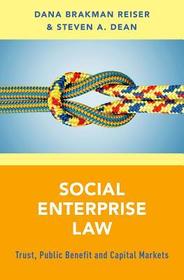
Social Enterprise Law
Trust, Public Benefit and Capital Markets
-
10% KEDVEZMÉNY?
- A kedvezmény csak az 'Értesítés a kedvenc témákról' hírlevelünk címzettjeinek rendeléseire érvényes.
- Kiadói listaár GBP 60.00
-
28 665 Ft (27 300 Ft + 5% áfa)
Az ár azért becsült, mert a rendelés pillanatában nem lehet pontosan tudni, hogy a beérkezéskor milyen lesz a forint árfolyama az adott termék eredeti devizájához képest. Ha a forint romlana, kissé többet, ha javulna, kissé kevesebbet kell majd fizetnie.
- Kedvezmény(ek) 10% (cc. 2 867 Ft off)
- Kedvezményes ár 25 799 Ft (24 570 Ft + 5% áfa)
Iratkozzon fel most és részesüljön kedvezőbb árainkból!
Feliratkozom
28 665 Ft

Beszerezhetőség
Becsült beszerzési idő: A Prosperónál jelenleg nincsen raktáron, de a kiadónál igen. Beszerzés kb. 3-5 hét..
A Prosperónál jelenleg nincsen raktáron.
Why don't you give exact delivery time?
A beszerzés időigényét az eddigi tapasztalatokra alapozva adjuk meg. Azért becsült, mert a terméket külföldről hozzuk be, így a kiadó kiszolgálásának pillanatnyi gyorsaságától is függ. A megadottnál gyorsabb és lassabb szállítás is elképzelhető, de mindent megteszünk, hogy Ön a lehető leghamarabb jusson hozzá a termékhez.
A termék adatai:
- Kiadó OUP USA
- Megjelenés dátuma 2017. november 9.
- ISBN 9780190249786
- Kötéstípus Keménykötés
- Terjedelem216 oldal
- Méret 155x239x20 mm
- Súly 431 g
- Nyelv angol 0
Kategóriák
Rövid leírás:
By providing a comprehensive survey of the U.S. laws and a bold vision for how legal institutions across the globe could be reformed, Social Enterprise Law offers new insights and approaches to help social enterprises raise the capital they need to flourish. It offers a rich guide for students, entrepreneurs, investors, and practitioners.
TöbbHosszú leírás:
Social enterprises represent a new kind of venture, dedicated to pursuing profits for owners and benefits for society. Social Enterprise Law provides tools that will allow them to raise the capital they need to flourish.
Social Enterprise Law weaves innovation in contract and corporate governance into powerful protections against insiders sacrificing goals such as environmental sustainability in the pursuit of short-term profits. Creating a stable balance between financial returns and public benefits will allow social entrepreneurs to team up with impact investors that share their vision of a double bottom line. Brakman Reiser and Dean show how novel legal technologies can allow social enterprises to access capital markets, including unconventional sources such as crowdfunding. With its straightforward insights into complex areas of the law, the book shows how a social mission can even be shielded from the turbulence of an acquisition or bankruptcy. It also shows why, as the metrics available to measure the impact of social missions on individuals and communities become more sophisticated, such legal innovations will continue to become more robust.
By providing a comprehensive survey of the U.S. laws and a bold vision for how legal institutions across the globe could be reformed, this book offers new insights and approaches to help social enterprises raise the capital they need to flourish. It offers a rich guide for students, entrepreneurs, investors, and practitioners.
This well-written and thoughtful work covers fundraising by mission-based companies from birth to death. In doing so, it highlights the unique problems that these enterprises raise, but also suggests that lawyers can play an important role in solving these problems. Given that the solutions to many urgent social and environmental issues may require significant capital, I hope that business lawyers take notice of this book, and use it to spur their thinking.
Tartalomjegyzék:
Introduction: Social Enterprise Law 2.0
Chapter 1: The Social Enterprise Trust Deficit
Chapter 2: Prioritizing Mission with a Mission-Protected Hybrid (MPH)
Chapter 3: Evaluating the Current Menu of Legal Forms for Social Enterprise
Chapter 4: From Form to Finance
Chapter 5: The Holy Grail of Retail Investment
Chapter 6: The Promise of Metrics
Chapter 7: Social Enterprise Exits
Conclusion

