

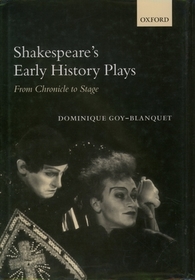
Shakespeare's Early History Plays
From Chronicle to Stage
-
10% KEDVEZMÉNY?
- A kedvezmény csak az 'Értesítés a kedvenc témákról' hírlevelünk címzettjeinek rendeléseire érvényes.
- Kiadói listaár GBP 195.00
-
88 042 Ft (83 850 Ft + 5% áfa)
Az ár azért becsült, mert a rendelés pillanatában nem lehet pontosan tudni, hogy a beérkezéskor milyen lesz a forint árfolyama az adott termék eredeti devizájához képest. Ha a forint romlana, kissé többet, ha javulna, kissé kevesebbet kell majd fizetnie.
- Kedvezmény(ek) 10% (kb. 8 804 Ft)
- Kedvezményes ár 79 238 Ft (75 465 Ft + 5% áfa)
Iratkozzon fel most és részesüljön kedvezőbb árainkból!
Feliratkozom
88 042 Ft

Beszerezhetőség
Megrendelésre a kiadó utánnyomja a könyvet. Rendelhető, de a szokásosnál kicsit lassabban érkezik meg.
Why don't you give exact delivery time?
A beszerzés időigényét az eddigi tapasztalatokra alapozva adjuk meg. Azért becsült, mert a terméket külföldről hozzuk be, így a kiadó kiszolgálásának pillanatnyi gyorsaságától is függ. A megadottnál gyorsabb és lassabb szállítás is elképzelhető, de mindent megteszünk, hogy Ön a lehető leghamarabb jusson hozzá a termékhez.
A termék adatai:
- Kiadó OUP Oxford
- Megjelenés dátuma 2003. szeptember 11.
- ISBN 9780198119876
- Kötéstípus Keménykötés
- Terjedelem324 oldal
- Méret 242x161x21 mm
- Súly 620 g
- Nyelv angol 0
Kategóriák
Rövid leírás:
Like many of his fellow playwrights, Shakespeare turned to national history for inspiration. In this study, Dominique Goy-Blanquet provides a close comparison of the Henry VI plays and Richard III with their sources, demonstrating how Shakespeare was able to meet not only the ideological but also the technical problems of turning history into drama, how by cutting, carving, shaping, and casting his unwieldy material into performable plays, he matured into the most influential dramatist and historian of his time.
TöbbHosszú leírás:
Like many of his fellow playwrights, Shakespeare turned to national history for inspiration. In this study, Dominique Goy-Blanquet provides a close comparison of the Henry VI plays and Richard III with their historical and theatrical sources, demonstrating how Shakespeare was able to meet not only the ideological but also the technical problems of turning history into drama, how by cutting, carving, shaping, casting his unwieldy material into performable plays, he matured into the most influential dramatist and historian of his time.
Recent criticism of Shakespeare's history plays has often consisted of fierce arguments over their ideological import and Shakespeare's position on the spectrum of current political opinions. This book, however, stems from the belief that a more constructive starting point for research is the exploration of the technical problems raised by turning heavy narratives into performable plays, rather than the political motives that could inpire a playwright's representation of national history.
Illuminating and instructive, Shakespeare's Early History Plays includes not only close investigation of the verbal, poetic, and political texture of the plays, but also provides a broad overview of the wider sixteenth-century historiographical contexts of the plays, and their significance to Shakespeare's oeuvre more generally.
a thorough, perceptive, and instructive book
Tartalomjegyzék:
I. The Mysteries of Henry VI
Critical waves
Classical shades
Cyclical storms
From page to stage
II. National Unity and Military Honour
The matter of ^1 Henry VI
Borrowing material
The theme of union
Space and time
III. Plotters and Plot
Refashioning history
Playing with time
Piecing out facts
IV. Grammatical Laws
From narrative to dramatic syntax
The appeal to the sources
Court masks, street masques
V. Unhappy Families
The narrative material of 3 Henry VI
Dramatic techniques
Critical rewriting
The literary tradition
VI. The Dawn of Tragedy
A turn for the worst
The new ethics
The actors of the drama
The tragic structure of history
To be continued
VII. Unnatural Born Killer
The text of Richard III
Plotting history
Hall's histories of Richard
Hall or Holinshed?
VIII. Certain Dregs of Conscience
Vergil's tragic hell
More's dramatic History
Poetic licence
Designing characters
Conclusion: A world to bustle in
Bibliography

