

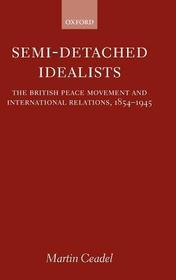
Semi-Detached Idealists
The British Peace Movement and International Relations, 1854-1945
-
10% KEDVEZMÉNY?
- A kedvezmény csak az 'Értesítés a kedvenc témákról' hírlevelünk címzettjeinek rendeléseire érvényes.
- Kiadói listaár GBP 312.50
-
141 093 Ft (134 375 Ft + 5% áfa)
Az ár azért becsült, mert a rendelés pillanatában nem lehet pontosan tudni, hogy a beérkezéskor milyen lesz a forint árfolyama az adott termék eredeti devizájához képest. Ha a forint romlana, kissé többet, ha javulna, kissé kevesebbet kell majd fizetnie.
- Kedvezmény(ek) 10% (kb. 14 109 Ft)
- Kedvezményes ár 126 984 Ft (120 938 Ft + 5% áfa)
Iratkozzon fel most és részesüljön kedvezőbb árainkból!
Feliratkozom
141 093 Ft

Beszerezhetőség
Megrendelésre a kiadó utánnyomja a könyvet. Rendelhető, de a szokásosnál kicsit lassabban érkezik meg.
Why don't you give exact delivery time?
A beszerzés időigényét az eddigi tapasztalatokra alapozva adjuk meg. Azért becsült, mert a terméket külföldről hozzuk be, így a kiadó kiszolgálásának pillanatnyi gyorsaságától is függ. A megadottnál gyorsabb és lassabb szállítás is elképzelhető, de mindent megteszünk, hogy Ön a lehető leghamarabb jusson hozzá a termékhez.
A termék adatai:
- Kiadó OUP Oxford
- Megjelenés dátuma 2000. december 7.
- ISBN 9780199241170
- Kötéstípus Keménykötés
- Terjedelem488 oldal
- Méret 243x163x31 mm
- Súly 851 g
- Nyelv angol 0
Kategóriák
Rövid leírás:
Building on his previous authoritative work on the British peace movement, Ceadel has produced a definitive historical analysis of its era of maturity - from the Crimean War to the Second World War. His book includes a discussion of the previously neglected late nineteenth century, an account of the movement's most influential period, the late 1920s and early 1930s, and an analysis of opposition to both world wars. Based on primary as well as secondary sources, it locates its subject both in the context of British domestic politics and in the idealist tradition of thinking about international relations.
TöbbHosszú leírás:
Britain's semi-detached geographical position has helped to give it the world's strongest peace movement. Secure enough from invasions to be influenced by an idealistic approach to international relations (unlike most of Europe), yet too close to the continent for isolationism to be an option (as it was in the United States), the country has provided favourable conditions for those aspiring not merely to prevent war but to abolish it.
The period from the Crimean War to the Second World War marked the British peace movement's age of maturity. In 1854, it was obliged for the first time to contest a decision - and moreover a highly popular one - to enter war. It survived the resulting adversity, and gradually rebuilt its position as an accepted voice in public life, though by the end of the nineteenth century its leading associations such as the Peace Society were losing vitality as they gained respectability. Stimulated by the First World War into radicalizing and reconstructing itself through the formation of such associations as the Union of Democratic Control, the No-Conscription Fellowship, and the Fellowship of Reconciliation, the movement endured another period of unpopularity before enjoying unprecedented influence during the inter-war years, the era of the League of Nations Union, the Oxford Union's 'King and country' debate, the Peace Ballot, and the Peace Pledge Union. Finally, however, Hitler discredited much of the agenda it had been promoting the previous century or more.
This book is the first comprehensive and authoritative study of this subject. It covers all significant peace associations and campaigns and is based on an extensive use of archival as well as printed sources. Its subject matter is of relevance both to historians of nineteenth and twentieth-century British politics and to specialists in international relations interested in the anti-realist tradition.
[Ceadel] is the foremost historian of the peace movement in Britain today. The breadth of his scholarship is a joy; the bibliography is a remarkable resource. Anywone with an interest in the roots of the peace movement would be impressed by his research, especially into the 19th century Peace Society ... This is an invaluable reference book ... It is an outstanding work and one for which Ceadel should be commended.
Tartalomjegyzék:
Introduction
Rise, February 1795 - October 1851
Struggle, October 1851- December 1866
Recovery, January 1867 - May 1882
Relapse, June 1882 - August 1898
Quickening, August 1898 - August 1914
Reconstruction, August 1914 - December 1918
Revival, January 1919 - September 1931
Stimulation, September 1931 - December 1935
Polarization, January 1936 - March 1939
Retreat, March 1939 - August 1945
Conclusion
Appendix One: National Peace Congresses
Appendix Two: Peace Associations
BIBLIOGRAPHY

