

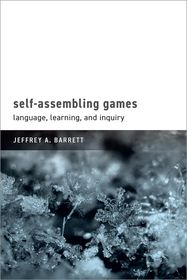
Self-Assembling Games
Language, Learning, and Inquiry
-
10% KEDVEZMÉNY?
- A kedvezmény csak az 'Értesítés a kedvenc témákról' hírlevelünk címzettjeinek rendeléseire érvényes.
- Kiadói listaár GBP 68.00
-
30 702 Ft (29 240 Ft + 5% áfa)
Az ár azért becsült, mert a rendelés pillanatában nem lehet pontosan tudni, hogy a beérkezéskor milyen lesz a forint árfolyama az adott termék eredeti devizájához képest. Ha a forint romlana, kissé többet, ha javulna, kissé kevesebbet kell majd fizetnie.
- Kedvezmény(ek) 10% (kb. 3 070 Ft)
- Kedvezményes ár 27 632 Ft (26 316 Ft + 5% áfa)
Iratkozzon fel most és részesüljön kedvezőbb árainkból!
Feliratkozom
30 702 Ft

Beszerezhetőség
Még nem jelent meg, de rendelhető. A megjelenéstől számított néhány héten belül megérkezik.
Why don't you give exact delivery time?
A beszerzés időigényét az eddigi tapasztalatokra alapozva adjuk meg. Azért becsült, mert a terméket külföldről hozzuk be, így a kiadó kiszolgálásának pillanatnyi gyorsaságától is függ. A megadottnál gyorsabb és lassabb szállítás is elképzelhető, de mindent megteszünk, hogy Ön a lehető leghamarabb jusson hozzá a termékhez.
A termék adatai:
- Kiadó OUP USA
- Megjelenés dátuma 2026. november 20.
- ISBN 9780197793541
- Kötéstípus Keménykötés
- Terjedelem312 oldal
- Méret 198x140x30 mm
- Súly 476 g
- Nyelv angol
- Illusztrációk 34 b/w figures and graphs 700
Kategóriák
Rövid leírás:
The theory of self-assembling games studies how evolutionary games emerge from basic interactions, and explores how the structure of a game may evolve on its continued play. Self Assembling Games offers readers new ways of considering game-theoretic ritualization, analyzing signalling, inference, compositional language, and attention as examples of this phenomenon.
TöbbHosszú leírás:
The theory of self-assembling games studies how evolutionary games emerge from basic interactions, and explores how once formed, the structure of a game may evolve on continued play. In Self Assembling Games, Jeffrey A. Barrett offers an incisive analysis of hierarchical, dialogue, and network-style games, illustrating how trial-and-error learners coevolve meaningful language and inferential capacities, how social structures that allow for more reliable learning emerge, and how learning itself develops in more sophisticated ways throughout this process.
In a philosophical exploration of self-assembling games' impact on animal and human behaviour, Barrett follows a continuous philosophical thread, providing a framework for a thoughtful pragmatic account of empirical inquiry. In demonstrating how simple agents may evolve meaningful language, useful social connections, and better ways of learning as they succeed and fail together in action, Self Assembling Games offers readers new ways of considering game-theoretic ritualization at large.
Tartalomjegyzék:
Chapter 1: Self assembly and games
Chapter 2: Learning to signal
Chapter 3: Generalized signaling games
Chapter 4: Assembling games from decisions
Chapter 5: Rule following and template transfer
Chapter 6: Modular composition and the evolution of salience
Chapter 7: The self-assembly of computation
Chapter 8: Learning to take turns
Chapter 9: The evolution of networks
Chapter 10: The self-assembling of inquiry
Chapter 11: The ways of learning
Chapter 12: Learning how to learn
Chapter 13: Self-assembling games and explanation

