

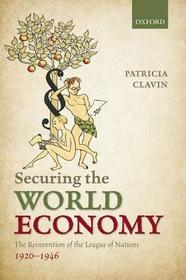
Securing the World Economy
The Reinvention of the League of Nations, 1920-1946
-
10% KEDVEZMÉNY?
- A kedvezmény csak az 'Értesítés a kedvenc témákról' hírlevelünk címzettjeinek rendeléseire érvényes.
- Kiadói listaár GBP 48.99
-
22 118 Ft (21 065 Ft + 5% áfa)
Az ár azért becsült, mert a rendelés pillanatában nem lehet pontosan tudni, hogy a beérkezéskor milyen lesz a forint árfolyama az adott termék eredeti devizájához képest. Ha a forint romlana, kissé többet, ha javulna, kissé kevesebbet kell majd fizetnie.
- Kedvezmény(ek) 10% (kb. 2 212 Ft)
- Kedvezményes ár 19 906 Ft (18 959 Ft + 5% áfa)
Iratkozzon fel most és részesüljön kedvezőbb árainkból!
Feliratkozom
22 118 Ft

Beszerezhetőség
Megrendelésre a kiadó utánnyomja a könyvet. Rendelhető, de a szokásosnál kicsit lassabban érkezik meg.
Why don't you give exact delivery time?
A beszerzés időigényét az eddigi tapasztalatokra alapozva adjuk meg. Azért becsült, mert a terméket külföldről hozzuk be, így a kiadó kiszolgálásának pillanatnyi gyorsaságától is függ. A megadottnál gyorsabb és lassabb szállítás is elképzelhető, de mindent megteszünk, hogy Ön a lehető leghamarabb jusson hozzá a termékhez.
A termék adatai:
- Kiadó OUP Oxford
- Megjelenés dátuma 2015. december 3.
- ISBN 9780198766483
- Kötéstípus Puhakötés
- Terjedelem414 oldal
- Méret 231x156x22 mm
- Súly 608 g
- Nyelv angol 0
Kategóriák
Rövid leírás:
The first study of the League of Nations' work in promoting economic and financial co-operation in the wake of the Great Depression, and the first major account of the League's relationship with the USA in the 1930s and 1940s.
TöbbHosszú leírás:
Securing the World Economy explains how efforts to support global capitalism became a core objective of the League of Nations. Based on new research drawn together from archives on three continents, it explores how the world's first ever inter-governmental organization confronted the powerful forces that influenced the global economy, and the prospects for peace. It traces how the League was drawn into economics and finance by the exigencies of the financial slump and hyperinflation after the First World War, when it provided essential financial support to Austria, Hungary, Greece, Bulgaria, and Estonia, and thereby established the founding principles of financial intervention, international oversight, and the twentieth-century notion of international 'development'.
But it is the impact of the Great Depression after 1929 that lies at the heart of this history. Patricia Clavin traces how the League of Nations sought to combat economic nationalism and promote economic and monetary co-operation in a variety of, sometimes contradictory, ways. Many of the economists, bureaucrats, and policy-advisors who worked for it played a seminal role in the history of international relations and social science, and their efforts did not end with the outbreak of the Second World War. In 1940 the League established an economic mission in the United States, where it contributed to the creation of organizations for the post-war world - the United Nations Organization, the IMF, the World Bank, the UN Food and Agriculture Organization - as well as to plans for European reconstruction and co-operation. It is a history that resonates deeply with challenges that face the twenty-first century world.
this is an impressive and meticulously researched monograph that has much to offer scholars working on all aspects of modern international history.
Tartalomjegyzék:
Introduction
The Multiverse of the League, 1920-1929
From Boom to Bust, 1929-1933
Conferences and their (Dis)contents, 1933-1934
All Things Trade and Currency, All Nations Great and Small, 1933-1936
Society and Economy in Global Partnership, 1935-1938
Scrutiny and Strategy: Contesting Economic Depressions, 1937-1939
The League at War and in Pieces, 1939-1940
Made in the USA, 1941-1943
The Architecture of a New World Order, 1944-1945
Conclusion
Sources and Bibliography

