

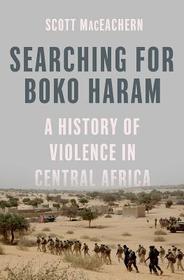
Searching for Boko Haram
A History of Violence in Central Africa
-
10% KEDVEZMÉNY?
- A kedvezmény csak az 'Értesítés a kedvenc témákról' hírlevelünk címzettjeinek rendeléseire érvényes.
- Kiadói listaár GBP 30.99
-
13 991 Ft (13 325 Ft + 5% áfa)
Az ár azért becsült, mert a rendelés pillanatában nem lehet pontosan tudni, hogy a beérkezéskor milyen lesz a forint árfolyama az adott termék eredeti devizájához képest. Ha a forint romlana, kissé többet, ha javulna, kissé kevesebbet kell majd fizetnie.
- Kedvezmény(ek) 10% (kb. 1 399 Ft)
- Kedvezményes ár 12 592 Ft (11 993 Ft + 5% áfa)
Iratkozzon fel most és részesüljön kedvezőbb árainkból!
Feliratkozom
13 991 Ft

Beszerezhetőség
Megrendelésre a kiadó utánnyomja a könyvet. Rendelhető, de a szokásosnál kicsit lassabban érkezik meg.
Why don't you give exact delivery time?
A beszerzés időigényét az eddigi tapasztalatokra alapozva adjuk meg. Azért becsült, mert a terméket külföldről hozzuk be, így a kiadó kiszolgálásának pillanatnyi gyorsaságától is függ. A megadottnál gyorsabb és lassabb szállítás is elképzelhető, de mindent megteszünk, hogy Ön a lehető leghamarabb jusson hozzá a termékhez.
A termék adatai:
- Kiadó OUP USA
- Megjelenés dátuma 2018. március 15.
- ISBN 9780190492526
- Kötéstípus Keménykötés
- Terjedelem248 oldal
- Méret 173x239x22 mm
- Súly 558 g
- Nyelv angol
- Illusztrációk 25 b/w halftones; 5 b/w line drawings 0
Kategóriák
Rövid leírás:
This book provides much-needed historical context to the recent rise of Boko Haram, which has terrorised northeastern Nigeria through the last six years. It particularly examines the links between Boko Haram and borderland phenomena -- especially slave-raiding, banditry, and smuggling -- in this region during the last millennium.
TöbbHosszú leírás:
This book places the insurgent group Boko Haram, which has terrorised northeastern Nigeria through the last six years, in an historical and cultural context. It examines cultural changes in the lands south of Lake Chad through deep time, showing how these ancient processes can help us think about Boko Haram's activities in the present. The archaeological and documentary record for this area is unusually rich for sub-Saharan Africa, and allows us to understand Boko Haram within an historical narrative that stretches back directly five centuries, with cultural origins that stretch even deeper into the past.
One important way to understand Boko Haram is as a frontier phenomenon, the most recent manifestation of processes of horrific violence, identity production and wealth creation that have been part of political relationships in this area of Central Africa through the last millennium. In striking ways, Boko Haram resembles the slave-raiders and warlords who figure in precolonial and colonial writings about the southern Lake Chad Basin. In modern times, these accounts are paralleled by the activities of smugglers, bandits (coupeurs de route, 'road cutters') and tax evaders, illegal actors who stand in complex relationships to the governments of modern African nation-states. The borderlands of these states are often places where the state refuses to exercise its full authority, because of the profits and opportunities that illegal and semi-legal activities afford, among others to state officials and bureaucrats. For local people, Boko Haram's actions are thus to a great extent understood in terms of slave-raids and borderlands. Those actions are not some mysterious, unprecedented eruption of violence and savagery: they can be understood within local contexts of politics and history. This book is written to counter exoticised portrayals of Boko Haram's activities, and of the region as a whole.
Scott MacEachern's Searching for Boko Haram is an original, arresting and almost beautiful book, which excavates the very distant past to understand what seems.
Tartalomjegyzék:
Introduction/Chronological Guide
Deep Time, Modern Consequences
Making the Mountains
Frontiers and Enslavement
Coupeurs de Route and Douaniers-Combattantes
Understanding Boko Haram
Conclusions
Selected Readings

