

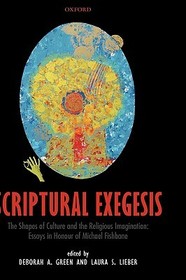
Scriptural Exegesis
The Shapes of Culture and the Religious Imagination: Essays in Honour of Michael Fishbane
-
10% KEDVEZMÉNY?
- A kedvezmény csak az 'Értesítés a kedvenc témákról' hírlevelünk címzettjeinek rendeléseire érvényes.
- Kiadói listaár GBP 71.00
-
32 056 Ft (30 530 Ft + 5% áfa)
Az ár azért becsült, mert a rendelés pillanatában nem lehet pontosan tudni, hogy a beérkezéskor milyen lesz a forint árfolyama az adott termék eredeti devizájához képest. Ha a forint romlana, kissé többet, ha javulna, kissé kevesebbet kell majd fizetnie.
- Kedvezmény(ek) 10% (kb. 3 205 Ft)
- Kedvezményes ár 28 851 Ft (27 477 Ft + 5% áfa)
Iratkozzon fel most és részesüljön kedvezőbb árainkból!
Feliratkozom
32 056 Ft

Beszerezhetőség
Megrendelésre a kiadó utánnyomja a könyvet. Rendelhető, de a szokásosnál kicsit lassabban érkezik meg.
Why don't you give exact delivery time?
A beszerzés időigényét az eddigi tapasztalatokra alapozva adjuk meg. Azért becsült, mert a terméket külföldről hozzuk be, így a kiadó kiszolgálásának pillanatnyi gyorsaságától is függ. A megadottnál gyorsabb és lassabb szállítás is elképzelhető, de mindent megteszünk, hogy Ön a lehető leghamarabb jusson hozzá a termékhez.
A termék adatai:
- Kiadó OUP Oxford
- Megjelenés dátuma 2009. február 26.
- ISBN 9780199206575
- Kötéstípus Keménykötés
- Terjedelem340 oldal
- Méret 241x163x24 mm
- Súly 694 g
- Nyelv angol 0
Kategóriák
Rövid leírás:
Scriptural Exegesis gathers an international community of scholars to consider the history of biblical interpretation and to question how exegesis shapes spiritual and cultural creativity in the light of Michael Fishbane's groundbreaking work. Eighteen chapters chart approaches to scriptural texts from ancient to modern times.
TöbbHosszú leírás:
Scriptural Exegesis gathers voices from an international community of scholars to consider the many facets of the history of biblical interpretation and to question how exegesis shapes spiritual and cultural creativity. Divided into four broadly chronological sections that chart a variety of approaches from ancient to modern times, the essays examine texts and problems rooted in the ancient world yet still of concern today. Eighteen chapters incorporate the expertise of contributors from a diverse range of disciplines, including ancient religion, philosophy, mysticism, and folklore. Each embraces the challenge of explicating complex and often esoteric writings in light of Michael Fishbane's groundbreaking work in exegesis.
It is a fitting tribute to a distinguished scholar that this Festschrift covers so much ground ... these are detailed technical papers which offer penetrating analysis and fascinating insights into neglected aspects of the Jewish and Christian interpretative traditions.
Tartalomjegyzék:
Introduction
I: The ancient Near East and Hebrew Bible: The shape of the text
Myth as historia divina and historia sacra
The Neo-Assyrian origins of the canon formula in Deuteronomy 13:1
Traditum and traditio: The case of Deuteronomy 17:14-20
The riddle of Psalm 111
Calling God names: An inner-biblical approach to the Tetragrammaton
II: Intertestamental, postbiblical, and rabbinic literature: Reimagining the text
The Suffering Servant: From Isaiah to the Dead Sea Scrolls
The Work of the Chariot and the Work of Creation as mystical teachings in Philo of Alexandria
A rabbinic disquisition of Leviticus 26:3-13: A utopian vision between Jews and Christians
Yearning for intimacy: Pesikta d'Rav Kahana and the temple
'If the text had not been written, it could not be said'
III: The medieval period: A new textual imagination
Cain, Abel, and brutism
'Sage is preferable to prophet': Revisioning midrashic imagination
On angels and biblical exegesis in thirteenth-century Ashkenaz
'Virgil in the Basket': Narrative as hermeneutics in Hebrew literature of the Middle Ages
Fabula: Concerning Christian exegesis in the Middle Ages
Women reading the Song of Songs in the Christian tradition
IV: The modern period: The human and divine in the text
Finding the radiance in the text: A Habad hasidic interpretation of the Exodus
Between sensual and heavenly love: Franz Rosenzweig's reading of the Song of Songs

