

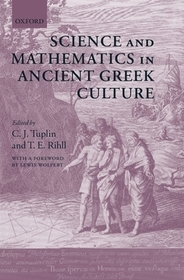
Science and Mathematics in Ancient Greek Culture
-
10% KEDVEZMÉNY?
- A kedvezmény csak az 'Értesítés a kedvenc témákról' hírlevelünk címzettjeinek rendeléseire érvényes.
- Kiadói listaár GBP 232.50
-
104 973 Ft (99 975 Ft + 5% áfa)
Az ár azért becsült, mert a rendelés pillanatában nem lehet pontosan tudni, hogy a beérkezéskor milyen lesz a forint árfolyama az adott termék eredeti devizájához képest. Ha a forint romlana, kissé többet, ha javulna, kissé kevesebbet kell majd fizetnie.
- Kedvezmény(ek) 10% (kb. 10 497 Ft)
- Kedvezményes ár 94 476 Ft (89 978 Ft + 5% áfa)
Iratkozzon fel most és részesüljön kedvezőbb árainkból!
Feliratkozom
104 973 Ft

Beszerezhetőség
Megrendelésre a kiadó utánnyomja a könyvet. Rendelhető, de a szokásosnál kicsit lassabban érkezik meg.
Why don't you give exact delivery time?
A beszerzés időigényét az eddigi tapasztalatokra alapozva adjuk meg. Azért becsült, mert a terméket külföldről hozzuk be, így a kiadó kiszolgálásának pillanatnyi gyorsaságától is függ. A megadottnál gyorsabb és lassabb szállítás is elképzelhető, de mindent megteszünk, hogy Ön a lehető leghamarabb jusson hozzá a termékhez.
A termék adatai:
- Kiadó OUP Oxford
- Megjelenés dátuma 2002. szeptember 26.
- ISBN 9780198152484
- Kötéstípus Keménykötés
- Terjedelem396 oldal
- Méret 242x163x26 mm
- Súly 917 g
- Nyelv angol
- Illusztrációk 8 halftones and numerous figures 0
Kategóriák
Rövid leírás:
Ancient Greece was the birthplace of science, which developed in the Hellenized culture of ancient Rome. This book, written by seventeen international experts, examines the role and achievement of science and mathematics in Greek antiquity through discussion of the linguistic, literary, political, religious, sociological, and technological factors which influenced scientific thought and practice. It locates science within ancient Greek society and culture, investigates its impact upon that society, and identifies it as a cultural phenomenon deserving no less attention than literary or artistic creativity.
TöbbHosszú leírás:
Ancient Greece was the birthplace of science, which developed in the Hellenized culture of ancient Rome. This volume locates science within ancient Greek society and culture, investigates its impact upon that society, and identifies it as a cultural phenomenon deserving no less attention than literary or artistic creativity.
Chapters by seventeen international experts examine the role and achievement of science and mathematics in Greek antiquity through discussion of the linguistic, literary, political, religious, sociological, and technological factors which influenced scientific thought and practice. Greek science was both motivated and constrained by wholly 'unscientific' cultural interests, and by ideas and biases arising from the language and the paradigms of the day. For example, it is here argued that the prediction of eclipses was not a concern of ancient astronomers until after 'non-scientific' authors such as the historian Livy, elaborating on a good story with a moral, suggested that it should be.
Familiar classical authors, such as Homer, Polybius, Cicero, and Pliny are here seen in a new light. Less-studied classical authors, such as Euclid, Hero, Galen, and Ptolemy, are also considered, and attention is drawn to areas where there is potential for new research and where editions and translations are still needed.
... this book provides an accessible insight into a number of different areas ... well-produced volume ... where Greek or Latin texts are given in the original, they are translated. The index is useful and thorough.
Tartalomjegyzék:
Foreword
Introduction: Greek Science in context
Words for sounds
Ptolemy's maps as an introduction to ancient science
Seismology and vulcanology in antiquity
The art of the commander and the emergence of predictive astronomy
Euctemon's parapegma
Instruments of Alexandrian astronomy: the uses of the equinoctial rings
The Dioptra of Heron of Alexandria
The machine and the city: hero of Alexandria's Belopoecia
Ancient atomism: promise and failure
Greek mathematicians: a group picture
Aristotle and mathematics
Euclid's Elements 9.14 and the Fundamental Theorem of Arithmetic
Ancient medicine: Asclepius transformed
Galen on the seat of the intellect: anatomical experiment and philosophical tradition
Practice makes perfect: processing materials in classical Athens
Distilling, sublimation, and the four elements: the aims and achievements of the earliest Greek chemists

