

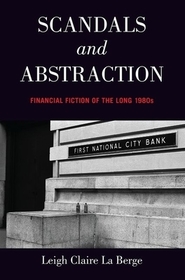
Scandals and Abstraction
Financial Fiction of the Long 1980s
-
10% KEDVEZMÉNY?
- A kedvezmény csak az 'Értesítés a kedvenc témákról' hírlevelünk címzettjeinek rendeléseire érvényes.
- Kiadói listaár GBP 33.99
-
15 346 Ft (14 615 Ft + 5% áfa)
Az ár azért becsült, mert a rendelés pillanatában nem lehet pontosan tudni, hogy a beérkezéskor milyen lesz a forint árfolyama az adott termék eredeti devizájához képest. Ha a forint romlana, kissé többet, ha javulna, kissé kevesebbet kell majd fizetnie.
- Kedvezmény(ek) 10% (cc. 1 535 Ft off)
- Kedvezményes ár 13 811 Ft (13 154 Ft + 5% áfa)
Iratkozzon fel most és részesüljön kedvezőbb árainkból!
Feliratkozom
15 346 Ft

Beszerezhetőség
Becsült beszerzési idő: A Prosperónál jelenleg nincsen raktáron, de a kiadónál igen. Beszerzés kb. 3-5 hét..
A Prosperónál jelenleg nincsen raktáron.
Why don't you give exact delivery time?
A beszerzés időigényét az eddigi tapasztalatokra alapozva adjuk meg. Azért becsült, mert a terméket külföldről hozzuk be, így a kiadó kiszolgálásának pillanatnyi gyorsaságától is függ. A megadottnál gyorsabb és lassabb szállítás is elképzelhető, de mindent megteszünk, hogy Ön a lehető leghamarabb jusson hozzá a termékhez.
A termék adatai:
- Kiadó OUP USA
- Megjelenés dátuma 2020. június 22.
- ISBN 9780190845988
- Kötéstípus Puhakötés
- Terjedelem242 oldal
- Méret 155x231x15 mm
- Súly 635 g
- Nyelv angol
- Illusztrációk 3 halftones 14
Kategóriák
Rövid leírás:
Scandals and Abstraction offers an in-depth study of epochal works like White Noise by Don DeLillo, American Psycho by Bret Easton Ellis, and Tom Wolfe's The Bonfire of the Vanities, alongside the key moments of financial history that inform them.
TöbbHosszú leírás:
The Long 1980s could be summed up handily in the annals of U.S. cultural history with the enduring markers of Ronald Reagan's presidency, Oliver Stone's film Wall Street, and Dire Straits's hit single "Money for Nothing." Despite their vast differences, each serves to underscore the confidence, jingoism, and optimism that powered the U.S. economy throughout the decade. Mining a wide range of literature, film, and financial print journalism, Scandals and Abstraction chronicles how American society's increasing concern with finance found expression in a large array of cultural materials that ultimately became synonymous with postmodernism.
The ever-present credit cards, monetary transactions, and ATMs in Don De Lillo's White Noise open this study as they serve as touchstones for its protagonist's sense of white masculinity and ground the novel's narrative form. Tom Wolfe's The Bonfire of the Vanities and Oliver Stone's Wall Street animate a subsequent chapter, as each is considered in light of the 1987 stock market crash and held up as a harbinger of a radical new realism that claimed a narrative monopoly on representing an emergent financial era. These works give way to the pornographic excess and violence of Bret Easton Ellis's epochal American Psycho, which is read alongside the popular 1980s genre of the financial autobiography. With a series of trenchant readings, La Berge argues that Ellis's novel can be best understood when examined alongside Ivan Boesky's Merger Mania, Donald Trump's The Art of the Deal, and T. Boone Pickens's Boone. A look at Jane Smiley's Good Faith and its plot surrounding the savings and loan crisis of the 1980s and 1990s, concludes the study, and considers how financial reportage became a template for much of our current writing about of finance.
Drawing on a diverse archive of novels, films, autobiographies, and journalism, Scandals and Abstraction provides a timely study of the economy's influence on fiction, and outlines a feedback loop whereby postmodernism became more canonical, realism became more postmodern, and finance became a distinct cultural object.
Theoretically sophisticated and politically engaged, Scandals and Abstraction is a tour-de-force treatment of how financial logics circulated in 1980s' literature and culture. La Berge asks compelling questions and the answers she provides offer startling insights into some of the ways financialization has altered our lives."
Tartalomjegyzék:
Introduction
Chapter 1. Personal Banking and Depersonalization in Don
DeLillo's White Noise
Chapter 2. Capitalist Realism: The 1987 Stock Market Crash
and the New Proprietary of Tom Wolfe and Oliver Stone
Chapter 3. "The Men Who Make The Killings": American
Psycho and the Genre of the Financial Autobiography
Chapter 4. Realism and Unreal Estate: The Savings and Loan
Scandals and the Epistemologies of American Finance
Coda

