

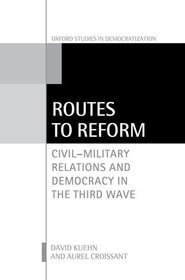
Routes to Reform
Civil-Military Relations and Democracy in the Third Wave
Sorozatcím: Oxford Studies in Democratization;
-
10% KEDVEZMÉNY?
- A kedvezmény csak az 'Értesítés a kedvenc témákról' hírlevelünk címzettjeinek rendeléseire érvényes.
- Kiadói listaár GBP 107.50
-
48 536 Ft (46 225 Ft + 5% áfa)
Az ár azért becsült, mert a rendelés pillanatában nem lehet pontosan tudni, hogy a beérkezéskor milyen lesz a forint árfolyama az adott termék eredeti devizájához képest. Ha a forint romlana, kissé többet, ha javulna, kissé kevesebbet kell majd fizetnie.
- Kedvezmény(ek) 10% (kb. 4 853 Ft)
- Kedvezményes ár 43 683 Ft (41 603 Ft + 5% áfa)
Iratkozzon fel most és részesüljön kedvezőbb árainkból!
Feliratkozom
48 536 Ft

Beszerezhetőség
Becsült beszerzési idő: A Prosperónál jelenleg nincsen raktáron, de a kiadónál igen. Beszerzés kb. 3-5 hét..
A Prosperónál jelenleg nincsen raktáron.
Why don't you give exact delivery time?
A beszerzés időigényét az eddigi tapasztalatokra alapozva adjuk meg. Azért becsült, mert a terméket külföldről hozzuk be, így a kiadó kiszolgálásának pillanatnyi gyorsaságától is függ. A megadottnál gyorsabb és lassabb szállítás is elképzelhető, de mindent megteszünk, hogy Ön a lehető leghamarabb jusson hozzá a termékhez.
A termék adatai:
- Kiadó OUP Oxford
- Megjelenés dátuma 2023. március 30.
- ISBN 9780198803362
- Kötéstípus Keménykötés
- Terjedelem272 oldal
- Méret 241x161x20 mm
- Súly 536 g
- Nyelv angol 275
Kategóriák
Rövid leírás:
This book examines the conditions under which new democracies succeed or fail in establishing firm and lasting civilian control of the military. It introduces a multi-dimensional conceptual framework to evaluate the degree of civilian control in new democracies, and tests a new theory on a large dataset from 66 countries.
TöbbHosszú leírás:
This book examines the conditions under which new democracies succeed or fail in establishing firm and lasting civilian control of the military. David Kuehn and Aurel Croissant introduce a multi-dimensional conceptual framework to evaluate the degree of civilian control in new democracies and to trace developments over time. The theory of civilian control in new democracies that they propose integrates rationalist, structuralist, and institutionalist arguments into a coherent model to explain when, how, and through which causal mechanism new democracies succeed or fail in establishing and sustaining civilian control over the military. This theory is tested on an original dataset on civilian control over the military in 66 countries that have made the transition from authoritarian to democratic rule at least once in the period from 1974 to 2010. The study traces the effects of different degrees of civilian control on the survival and democratic quality of third wave democracies, combining large-N statistical analyses with detailed case study narratives of several countries. The book establishes a comprehensive understanding of the conditions and processes under which third wave democracies succeeded or failed in establishing firm and lasting civilian control of the military-and its consequences for the survival and quality of the new democratic structures, processes, and practices.
One of the most important books on both education policy, and governance, in recent years...The book moves beyond questions of educational spending to engage seriously with education systems as complex services, examining the politics of hiring, training, and structuring teacher professionalism. Schneider masterfully combines an analysis of how different constellations of electoral demand and teacher mobilization operate to shape varying modes of reform. The book draws on multiple rich and extremely well researched cases. The result is a book that provides original theorizing both of education policy and the dynamics governance and organizational dynamics under different structures of union mobilization and clientelist politics more generally.
Tartalomjegyzék:
Introduction
Conceptualizing and theorizing civilian control
Mapping and explanining civilian control in third wave democracies
Reforming civil-military relations
The effect of civilian control on democracy
Democratic survival and quality
Conclusion
Bibliography
Index

