

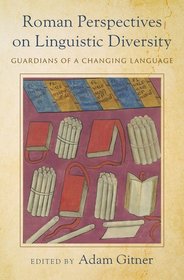
Roman Perspectives on Linguistic Diversity
Guardians of a Changing Language
-
10% KEDVEZMÉNY?
- A kedvezmény csak az 'Értesítés a kedvenc témákról' hírlevelünk címzettjeinek rendeléseire érvényes.
- Kiadói listaár GBP 60.00
-
27 090 Ft (25 800 Ft + 5% áfa)
Az ár azért becsült, mert a rendelés pillanatában nem lehet pontosan tudni, hogy a beérkezéskor milyen lesz a forint árfolyama az adott termék eredeti devizájához képest. Ha a forint romlana, kissé többet, ha javulna, kissé kevesebbet kell majd fizetnie.
- Kedvezmény(ek) 10% (kb. 2 709 Ft)
- Kedvezményes ár 24 381 Ft (23 220 Ft + 5% áfa)
Iratkozzon fel most és részesüljön kedvezőbb árainkból!
Feliratkozom
27 090 Ft

Beszerezhetőség
Megrendelésre a kiadó utánnyomja a könyvet. Rendelhető, de a szokásosnál kicsit lassabban érkezik meg.
Why don't you give exact delivery time?
A beszerzés időigényét az eddigi tapasztalatokra alapozva adjuk meg. Azért becsült, mert a terméket külföldről hozzuk be, így a kiadó kiszolgálásának pillanatnyi gyorsaságától is függ. A megadottnál gyorsabb és lassabb szállítás is elképzelhető, de mindent megteszünk, hogy Ön a lehető leghamarabb jusson hozzá a termékhez.
A termék adatai:
- Kiadó OUP USA
- Megjelenés dátuma 2024. január 23.
- ISBN 9780197611975
- Kötéstípus Keménykötés
- Terjedelem304 oldal
- Méret 157x224x40 mm
- Súly 567 g
- Nyelv angol
- Illusztrációk 16, B/W 456
Kategóriák
Rövid leírás:
This collection of essays explores how Roman scholars and grammarians addressed different kinds of linguistic diversity within the Roman Republic and Empire. It is a follow-up to Robert Kaster's Guardians of Language: The Grammarian and Society in Late Antiquity.
TöbbHosszú leírás:
Thirty years ago Robert Kaster's Guardians of Language: The Grammarian and Society in Late Antiquity investigated ancient Greco-Roman grammarians as social agents within their social and cultural context. This collection of twelve essays develops that line of inquiry by focusing on one dimension of their activity: how Roman grammarians - as well as scholars and intellectuals more broadly - described, made sense of, and resisted linguistic diversity within the Roman republic and empire. This includes social and diachronic variety within Latin as well as multilingual contact with Greek and other Mediterranean languages. The essays cover five centuries of Latin reflection on language, from Varro to the fifth or sixth century CE. The book concludes with an autobiographical Epilogue by Robert Kaster about the origins of Guardians of Language and updates to the prosopography of known ancient grammarians found in Guardians.
How does a language that has become the lingua franca of an Empire change over time? Who drives such change, and how is it seen by intellectuals and by those who oversee élite education-the grammatici? These essays explore these questions in detail, insightfully, often humorously. The Epilogue, Robert Kaster's own account of the accidental genesis of Guardians of Language, shows why its 30th anniversary deserves celebration, and displays the wit and modesty that helped inspire the loyalty of Kaster's students and colleagues alike. Kaster's updated prosopography of Roman grammatici makes the book indispensable for students of that no longer quite so neglected group of guardians of the Latin language.
Tartalomjegyzék:
Acknowledgments
Contributors
Short Title Abbreviations
Preface
Adam Gitner
Introduction
1. Counterfeit and Coinage: Gresham's Law and the Grammarian
James E. G. Zetzel
Part I: Varro
2. Varro the Conservative?
Katharina Volk
3. Varro and the Sabine Language in the De lingua Latina
Wolfgang D. C. de Melo
4. Varro's Word Trees
Andreas T. Zanker
Part II: Professional Grammarians
5. The Use of Greek in Diomedes' Ars grammatica
Bruno Rochette
6. The Grammarian Consentius on Language Change and Variation
Tommaso Mari
7. Antiquus = squalidus? Pompeius' Attitude towards Antiquity
Anna Zago
8. T(w)o Be or Not T(w)o Be: The dualis numerus according to Latin Grammarians up to the Early Middle Ages
Tim Denecker
9. Anonymous Grammatical Scholarship: Insights from an Annotated Juvenal Codex from Egypt
Alessandro Garcea and Maria Chiara Scappaticcio
Part III: Scholars and Intellectuals
10. Civic Metaphors for Lexical Borrowing from Seneca to Gellius
Adam Gitner
11. Grammar and Grammarians, Linguistic and Social Change from Gellius to Macrobius
Leofranc Holford-Strevens
12. Language Variation and Grammatical Theory in Roman Legal Texts
Rolando Ferri
Epilogue
The (Very Fragile) Origins of Guardians of Language
Robert A. Kaster
Prosopographical Addenda to Guardians of Language
Robert A. Kaster
Bibliography
General Index
Index of Notable Passages

