

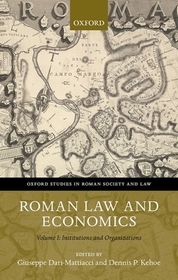
Roman Law and Economics
Institutions and Organizations Volume I
Sorozatcím: Oxford Studies in Roman Society & Law;
-
10% KEDVEZMÉNY?
- A kedvezmény csak az 'Értesítés a kedvenc témákról' hírlevelünk címzettjeinek rendeléseire érvényes.
- Kiadói listaár GBP 125.00
-
56 437 Ft (53 750 Ft + 5% áfa)
Az ár azért becsült, mert a rendelés pillanatában nem lehet pontosan tudni, hogy a beérkezéskor milyen lesz a forint árfolyama az adott termék eredeti devizájához képest. Ha a forint romlana, kissé többet, ha javulna, kissé kevesebbet kell majd fizetnie.
- Kedvezmény(ek) 10% (kb. 5 643 Ft)
- Kedvezményes ár 50 794 Ft (48 375 Ft + 5% áfa)
Iratkozzon fel most és részesüljön kedvezőbb árainkból!
Feliratkozom
56 437 Ft

Beszerezhetőség
Megrendelésre a kiadó utánnyomja a könyvet. Rendelhető, de a szokásosnál kicsit lassabban érkezik meg.
Why don't you give exact delivery time?
A beszerzés időigényét az eddigi tapasztalatokra alapozva adjuk meg. Azért becsült, mert a terméket külföldről hozzuk be, így a kiadó kiszolgálásának pillanatnyi gyorsaságától is függ. A megadottnál gyorsabb és lassabb szállítás is elképzelhető, de mindent megteszünk, hogy Ön a lehető leghamarabb jusson hozzá a termékhez.
A termék adatai:
- Kiadás sorszáma és címe :Volume I
- Kiadó OUP Oxford
- Megjelenés dátuma 2020. május 28.
- ISBN 9780198787204
- Kötéstípus Keménykötés
- Terjedelem368 oldal
- Méret 222x147x26 mm
- Súly 592 g
- Nyelv angol
- Illusztrációk 6 black-and-white illustrations 0
Kategóriák
Rövid leírás:
The economic analysis of Roman law has enormous potential to illuminate the origins of Roman legal institutions in response to changes in the economic activities that they regulated. These two volumes combine approaches from legal history and economic history with methods borrowed from economics to offer a new interdisciplinary approach.
TöbbHosszú leírás:
Ancient Rome is the only society in the history of the western world whose legal profession evolved autonomously, distinct and separate from institutions of political and religious power. Roman legal thought has left behind an enduring legacy and exerted enormous influence on the shaping of modern legal frameworks and systems, but its own genesis and context pose their own explanatory problems. The economic analysis of Roman law has enormous untapped potential in this regard: by exploring the intersecting perspectives of legal history, economic history, and the economic analysis of law, the two volumes of Roman Law and Economics are able to offer a uniquely interdisciplinary examination of the origins of Roman legal institutions, their functions, and their evolution over a period of more than 1000 years, in response to changes in the underlying economic activities that those institutions regulated.
Volume I explores these legal institutions and organizations in detail, from the constitution of the Roman Republic to the management of business in the Empire, while Volume II covers the concepts of exchange, ownership, and disputes, analysing the detailed workings of credit, property, and slavery, among others. Throughout each volume, contributions from specialists in legal and economic history, law, and legal theory are underpinned by rigorous analysis drawing on modern empirical and theoretical techniques and methodologies borrowed from economics. In demonstrating how these can be fruitfully applied to the study of ancient societies, with due deference to the historical context, Roman Law and Economics opens up a host of new avenues of research for scholars and students in each of these fields and in the social sciences more broadly, offering new ways in which different modes of enquiry can connect with and inform each other.
...a very necessary step in historical research.
Tartalomjegyzék:
Frontmatter
List of Figures
List of Tables
List of Contributors
Rome and the Economics of Ancient Law I
I. Institutions
What Can the Endogenous Institutions Literature Tell Us About Ancient Rome?
The Constitution of the Roman Republic
Law-Making and Economic Change during the Republic and Early Empire
II. Markets and Trade
Setting the Rules of the Game: The Market and its Working in the Roman Empire
Statistics in Ancient History: Prices and Trade in the Pax Romana
The Organization of India-to-Rome Trade: Loans and Agents in the Muziris Papyrus
III. Organizing Business
Incomplete Organizations: Legal Entities and Asset Partitioning in Roman Commerce
Roman Business Associations
Agency Problems and Organizational Costs in Slave-Run Businesses
Mandate and the Management of Business in the Roman Empire
Endmatter
Index

