

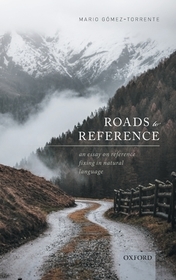
Roads to Reference
An Essay on Reference Fixing in Natural Language
-
10% KEDVEZMÉNY?
- A kedvezmény csak az 'Értesítés a kedvenc témákról' hírlevelünk címzettjeinek rendeléseire érvényes.
- Kiadói listaár GBP 84.00
-
37 926 Ft (36 120 Ft + 5% áfa)
Az ár azért becsült, mert a rendelés pillanatában nem lehet pontosan tudni, hogy a beérkezéskor milyen lesz a forint árfolyama az adott termék eredeti devizájához képest. Ha a forint romlana, kissé többet, ha javulna, kissé kevesebbet kell majd fizetnie.
- Kedvezmény(ek) 10% (cc. 3 793 Ft off)
- Kedvezményes ár 34 133 Ft (32 508 Ft + 5% áfa)
Iratkozzon fel most és részesüljön kedvezőbb árainkból!
Feliratkozom
37 926 Ft

Beszerezhetőség
Becsült beszerzési idő: A Prosperónál jelenleg nincsen raktáron, de a kiadónál igen. Beszerzés kb. 3-5 hét..
A Prosperónál jelenleg nincsen raktáron.
Why don't you give exact delivery time?
A beszerzés időigényét az eddigi tapasztalatokra alapozva adjuk meg. Azért becsült, mert a terméket külföldről hozzuk be, így a kiadó kiszolgálásának pillanatnyi gyorsaságától is függ. A megadottnál gyorsabb és lassabb szállítás is elképzelhető, de mindent megteszünk, hogy Ön a lehető leghamarabb jusson hozzá a termékhez.
A termék adatai:
- Kiadó OUP Oxford
- Megjelenés dátuma 2019. november 28.
- ISBN 9780198846277
- Kötéstípus Keménykötés
- Terjedelem256 oldal
- Méret 238x157x21 mm
- Súly 522 g
- Nyelv angol 0
Kategóriák
Rövid leírás:
How do words come to stand for what they stand for? Is a word's reference fully identified or described by conventions known to the users of the word? Mario Gómez-Torrente tackles these questions and many more as he takes on the difficult task of describing the conventions which lead certain words to refer to what they do.
TöbbHosszú leírás:
How is it that words come to stand for the things they stand for? Is the thing that a word stands for - its reference - fully identified or described by conventions known to the users of the word? Or is there a more roundabout relation between the reference of a word and the conventions that determine or fix it? Do words like 'water', 'three', and 'red' refer to appropriate things, just as the word 'Aristotle' refers to Aristotle? If so, which things are these, and how do they come to be referred to by those words?
In Roads to Reference, Mario Gómez-Torrente provides novel answers to these and other questions that have been of traditional interest in the theory of reference. The book introduces a number of cases of apparent indeterminacy of reference for proper names, demonstratives, and natural kind terms, which suggest that reference-fixing conventions for them adopt the form of lists of merely sufficient conditions for reference and reference failure. He then provides arguments for a new anti-descriptivist picture of those kinds of words, according to which the reference-fixing conventions for them do not describe their reference. This book also defends realist and objectivist accounts of the reference of ordinary natural kind nouns, numerals, and adjectives for sensible qualities. According to these accounts these words refer, respectively, to 'ordinary kinds', cardinality properties, and properties of membership in intervals of sensible dimensions, and these things are fixed in subtle ways by associated reference-fixing conventions.
Tartalomjegyzék:
Reference: Problems and Promises
Demonstratives and Conflicting Intentions
Proper Names and Referential Indeterminacy
Arabic Numerals and the Problem of Mathematical Sophistication
Nouns for Natural Kinds and the Problem of Arbitrariness
Words for Sensible Qualities and the Problem of Perceptual Variation
Concluding Notes

