

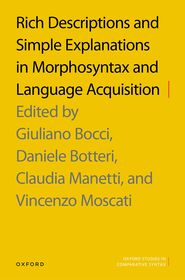
Rich Descriptions and Simple Explanations in Morphosyntax and Language Acquisition
Sorozatcím: Oxford Studies in Comparative Syntax;
-
10% KEDVEZMÉNY?
- A kedvezmény csak az 'Értesítés a kedvenc témákról' hírlevelünk címzettjeinek rendeléseire érvényes.
- Kiadói listaár GBP 112.50
-
50 793 Ft (48 375 Ft + 5% áfa)
Az ár azért becsült, mert a rendelés pillanatában nem lehet pontosan tudni, hogy a beérkezéskor milyen lesz a forint árfolyama az adott termék eredeti devizájához képest. Ha a forint romlana, kissé többet, ha javulna, kissé kevesebbet kell majd fizetnie.
- Kedvezmény(ek) 10% (kb. 5 079 Ft)
- Kedvezményes ár 45 714 Ft (43 538 Ft + 5% áfa)
Iratkozzon fel most és részesüljön kedvezőbb árainkból!
Feliratkozom
50 793 Ft

Beszerezhetőség
Megrendelésre a kiadó utánnyomja a könyvet. Rendelhető, de a szokásosnál kicsit lassabban érkezik meg.
Why don't you give exact delivery time?
A beszerzés időigényét az eddigi tapasztalatokra alapozva adjuk meg. Azért becsült, mert a terméket külföldről hozzuk be, így a kiadó kiszolgálásának pillanatnyi gyorsaságától is függ. A megadottnál gyorsabb és lassabb szállítás is elképzelhető, de mindent megteszünk, hogy Ön a lehető leghamarabb jusson hozzá a termékhez.
A termék adatai:
- Kiadó OUP Oxford
- Megjelenés dátuma 2024. június 27.
- ISBN 9780198889472
- Kötéstípus Keménykötés
- Terjedelem480 oldal
- Méret 241x165x31 mm
- Súly 872 g
- Nyelv angol 499
Kategóriák
Rövid leírás:
This volume offers new perspectives on the tension between the rich patterns of language variation that emerge from comparative studies and the quest for simple theoretical primitives. The chapters analyze a wide range of phenomena, and relate them to fundamental questions of universality, linguistic variation, and learnability.
TöbbHosszú leírás:
This volume offers new perspectives on the tension between the rich patterns of language variation that emerge from comparative studies and the quest for simple theoretical primitives. The chapters explore the debate between Cartography and Minimalism: on the one hand, the need for detailed and articulated descriptions of the clausal architecture, and on the other, the endeavor to reduce the theoretical apparatus to fundamental computational mechanisms.
The first part of the book begins with a reflection on the goals of modern linguistic theory, and investigates the principles of human language, in an effort to subsume the regularities of particular grammars under a small set of morphosyntactic and semantic primitives. The second part examines the clausal structure - both the CP-layer and the IP-layer - from a comparative perspective, which directly relates to the fundamental questions of universality, linguistic variation, and learnability addressed in the first part of the book. With chapters written by world-leading linguists who analyze a wide range of old and new phenomena, the volume will be a valuable resource for researchers and students interested in theoretical linguistics and language development.
Tartalomjegyzék:
Introduction
Part I. Foundational issues: Principles, primitives, and explanations in generative grammar
Genuine explanation
Four types of quantifiers at the interface between syntax and logic
The explanatory power of the subjacency principle
The Strict Cycle Condition: 'One cycle to rule them all'
A more demanding approach to suppletion
Truncation vs reduction in development
Part II. Comparative perspectives on the functional structure of the clause
Recategorizing C
Wh-phrases as genuine focus operators
Some (but not all) movement types systematically violate islands
Comprehension and production of sentences with V-C movement in orally-trained children with hearing impairment
Micro-variation in imperatives: Enclisis and mesoclisis in Italian and Arbëresh varieties
The syntax of Romance clitics and selective clitic climbing
The Latin passive morpheme /-r/ and its morphosyntactic similarity with Romance SI
Subject ellipsis and impersonal pronouns
Some basic properties of Mandarin resultative clusters: A measure of progress
From Bantu subject-object reversal to inverted copular sentences: How “low” focalization and smuggling circumvent Relative Minimality violations

