

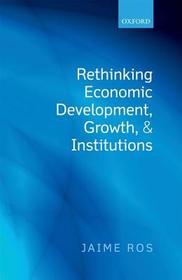
Rethinking Economic Development, Growth, and Institutions
-
10% KEDVEZMÉNY?
- A kedvezmény csak az 'Értesítés a kedvenc témákról' hírlevelünk címzettjeinek rendeléseire érvényes.
- Kiadói listaár GBP 125.00
-
59 718 Ft (56 875 Ft + 5% áfa)
Az ár azért becsült, mert a rendelés pillanatában nem lehet pontosan tudni, hogy a beérkezéskor milyen lesz a forint árfolyama az adott termék eredeti devizájához képest. Ha a forint romlana, kissé többet, ha javulna, kissé kevesebbet kell majd fizetnie.
- Kedvezmény(ek) 10% (cc. 5 972 Ft off)
- Kedvezményes ár 53 747 Ft (51 188 Ft + 5% áfa)
Iratkozzon fel most és részesüljön kedvezőbb árainkból!
Feliratkozom
59 718 Ft

Beszerezhetőség
Megrendelésre a kiadó utánnyomja a könyvet. Rendelhető, de a szokásosnál kicsit lassabban érkezik meg.
Why don't you give exact delivery time?
A beszerzés időigényét az eddigi tapasztalatokra alapozva adjuk meg. Azért becsült, mert a terméket külföldről hozzuk be, így a kiadó kiszolgálásának pillanatnyi gyorsaságától is függ. A megadottnál gyorsabb és lassabb szállítás is elképzelhető, de mindent megteszünk, hogy Ön a lehető leghamarabb jusson hozzá a termékhez.
A termék adatai:
- Kiadó OUP Oxford
- Megjelenés dátuma 2013. október 3.
- ISBN 9780199684809
- Kötéstípus Keménykötés
- Terjedelem470 oldal
- Méret 237x162x35 mm
- Súly 860 g
- Nyelv angol
- Illusztrációk 76 Figures, 24 Tables 0
Kategóriák
Rövid leírás:
Presents the contributions that early development theory can make to growth economics in answering why some countries are richer than others and why some economies grow faster than others.
TöbbHosszú leírás:
Why are some countries richer than others? Why do some economies grow so much faster than others do? Do economies tend to converge to similar levels of per capita income? Or is catching up simply impossible? If modern technology has shown the potential to raise living standards to first-world levels, why is it that the vast majority of the world's population lives in poverty in underdeveloped countries? These questions have been at the heart of development economics since its inception several decades ago and are now at the center of the research agenda of the modern economics of growth.
This book reviews the answers to these questions in the contemporary fields of growth theory and comparative development. It is a sequel to Development Theory and the Economics of Growth published in 2000 with the aim to vindicate the theoretical insights and accumulated empirical knowledge of classical development economics and to integrate them into the mainstream of modern growth economics. The growth and development fields have expanded in the last twelve years in welcome directions that aim to deepen our understanding of the fundamental determinants of comparative development. This new book evaluates these new directions, including developments in endogenous growth theory and economic geography as well as the rise and challenge of the new institutional economics, in the light of the earlier, classical contributions to development theory.
Tartalomjegyzék:
Introduction
Some Stylized Facts of Economic Development
Part I. Neoclassical and Endogenous Growth Models
Basic Neoclassical and Endogenous Growth Models
Endogenous Savings and International Capital Mobility in the Neoclassical Model
Human Capital in Neoclassical and Endogenous Growth Models
Industrial Differentiation and Creative Destruction in New Growth Theory
Part II. Classical Development Theory
The Lewis Model and the Labor Surplus Economy
Increasing Returns, External Economies, and Multiple Equilibria
Internal Economies, Imperfect Competition, and Pecuniary Externalities
Openness and the Big Push: Criticisms and Extensions of Classical Development Theory
Part III. Aggregate Demand and Growth
Effective Demand and Factor Accumulation
Demand-Driven Technical Change, the Real Exchange Rate, and Growth
Kaleckí´s Dual Economy Model and Structuralist Growth Models
Debt Traps and Growth Collapses
Part IV. Deep Determinants of Comparative Development
Trade and Development
Developmental Effects of Natural Resource Abundance
Inequality and Middle Income Traps
Institutions and Development
Geography, Colonialism, and Underdevelopment
Successes and Failures in Economic Development: The Keys to the Kingdom

