

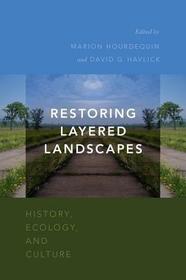
Restoring Layered Landscapes
History, Ecology, and Culture
-
10% KEDVEZMÉNY?
- A kedvezmény csak az 'Értesítés a kedvenc témákról' hírlevelünk címzettjeinek rendeléseire érvényes.
- Kiadói listaár GBP 125.00
-
56 437 Ft (53 750 Ft + 5% áfa)
Az ár azért becsült, mert a rendelés pillanatában nem lehet pontosan tudni, hogy a beérkezéskor milyen lesz a forint árfolyama az adott termék eredeti devizájához képest. Ha a forint romlana, kissé többet, ha javulna, kissé kevesebbet kell majd fizetnie.
- Kedvezmény(ek) 10% (cc. 5 644 Ft off)
- Kedvezményes ár 50 794 Ft (48 375 Ft + 5% áfa)
Iratkozzon fel most és részesüljön kedvezőbb árainkból!
Feliratkozom
56 437 Ft

Beszerezhetőség
Megrendelésre a kiadó utánnyomja a könyvet. Rendelhető, de a szokásosnál kicsit lassabban érkezik meg.
Why don't you give exact delivery time?
A beszerzés időigényét az eddigi tapasztalatokra alapozva adjuk meg. Azért becsült, mert a terméket külföldről hozzuk be, így a kiadó kiszolgálásának pillanatnyi gyorsaságától is függ. A megadottnál gyorsabb és lassabb szállítás is elképzelhető, de mindent megteszünk, hogy Ön a lehető leghamarabb jusson hozzá a termékhez.
A termék adatai:
- Kiadó OUP USA
- Megjelenés dátuma 2015. november 12.
- ISBN 9780190240318
- Kötéstípus Keménykötés
- Terjedelem290 oldal
- Méret 160x236x22 mm
- Súly 610 g
- Nyelv angol 0
Kategóriák
Rövid leírás:
Restoring Layered Landscapes explores ecological restoration in complex landscapes, where ecosystems intertwine with important sociopolitical meanings.
TöbbHosszú leírás:
Restoring Layered Landscapes brings together historians, geographers, philosophers, and interdisciplinary scholars to explore ecological restoration in landscapes with complex histories shaped by ongoing interactions between humans and nature. For many decades, ecological restoration - particularly in the United States - focused on returning degraded sites to conditions that prevailed prior to human influence. This model has been broadened in recent decades, and restoration now increasingly focuses on the recovery of ecological functions and processes rather than on returning a site to a specific historical state. Nevertheless, neither the theory nor the practice of restoration has fully come to terms with the challenges of restoring layered landscapes, where nature and culture shape one another in deep and ongoing relationships.
Former military and industrial sites provide paradigmatic examples of layered landscapes. Many of these sites are not only characterized by natural ecosystems worth preserving and restoring, but also embody significant political, social, and cultural histories. This volume grapples with the challenges of restoring and interpreting such complex sites: What should we aim to restore in such places? How can restoration adequately take the legacies of human use into account? Should traces of the past be left on the landscape, and how can interpretive strategies be creatively employed to make visible the complex legacies of an open pit mine or chemical weapons manufacturing plant?
Restoration aims to create new value, but not always without loss. Restoration often disrupts existing ecosystems, infrastructure, and artifacts. The chapters in this volume consider what restoration can tell us more generally about the relationship between continuity and change, and how the past can and should inform our thinking about the future. These insights, in turn, will help foster a more thoughtful approach to human-environment relations in an era of unprecedented anthropogenic global environmental change.
Tartalomjegyzék:
Acknowledgements
Contributors
INTRODUCTION
Chapter 1: Ecological Restoration and Layered Landscapes
Marion Hourdequin and David Havlick
PART ONE: THEORETICAL PERSPECTIVES ON THE RESTORATION OF LAYERED LANDSCAPES
Chapter 2: Ecological Restoration, Continuity, and Change: Negotiating History and Meaning in Layered Landscapes
Marion Hourdequin
Chapter 3: The Different Faces of History in Postindustrial Landscapes
Jozef Keulartz
Chapter 4: Nature and Our Sense of Loss
Alan Holland
Chapter 5: Layered Industrial Sites: Experimental Landscapes and the Virtues of Ignorance
Matthias Gross
PART TWO: APPROACHING LAYERED LANDSCAPES: RESTORATION IN CONTEXT
Chapter 6: Restoring Wildness to the Scottish Highlands: A Landscape of Legacies
Holly Deary
Chapter 7: Environmental Versus Heritage Stewardship: Nova Scotia's Annapolis River and the Canadian Heritage River System
Jennifer Welchman
Chapter 8: 'Get Lost in the Footnotes of History': The Restorative Afterlife of Rocky Flats, Colorado
Peter Coates
Chapter 9: Restoration, History, and Values at Transitioning Military Sites in the U.S.
David Havlick
PART THREE: REPRESENTATION AND INTERPRETATION OF LAYERED LANDSCAPES
Chapter 10: Slavery, Freedom, and the Cultural Landscape: Restoration and Interpretation of Monocacy National Battlefield
John Spiers
Chapter 11: Re-Naturalization and Industrial Heritage in America's Largest Superfund Site: The Case of the Warm Springs Ponds in Montana's Clark Fork Superfund Site
Fred Quivik
Chapter 12: Material Transformations: Urban Art and Environmental Justice
Mrill Ingram
Chapter 13: Layered Landscapes, Conflicting Narratives and Environmental Art: Painful Memories, Embarrassing Histories of Place
Martin Drenthen
CONCLUSION
Chapter 14: Layered Landscapes as Models for Restoration and Conservation
David Havlick and Marion Hourdequin
Index

