

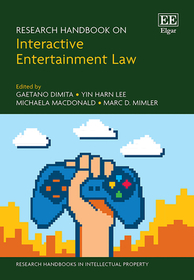
Research Handbook on Interactive Entertainment Law
Sorozatcím: Research Handbooks in Intellectual Property series;
-
10% KEDVEZMÉNY?
- A kedvezmény csak az 'Értesítés a kedvenc témákról' hírlevelünk címzettjeinek rendeléseire érvényes.
- Kiadói listaár GBP 215.00
-
97 072 Ft (92 450 Ft + 5% áfa)
Az ár azért becsült, mert a rendelés pillanatában nem lehet pontosan tudni, hogy a beérkezéskor milyen lesz a forint árfolyama az adott termék eredeti devizájához képest. Ha a forint romlana, kissé többet, ha javulna, kissé kevesebbet kell majd fizetnie.
- Kedvezmény(ek) 10% (kb. 9 707 Ft)
- Kedvezményes ár 87 365 Ft (83 205 Ft + 5% áfa)
Iratkozzon fel most és részesüljön kedvezőbb árainkból!
Feliratkozom
97 072 Ft

Beszerezhetőség
Becsült beszerzési idő: A Prosperónál jelenleg nincsen raktáron, de a kiadónál igen. Beszerzés kb. 3-5 hét..
A Prosperónál jelenleg nincsen raktáron.
Why don't you give exact delivery time?
A beszerzés időigényét az eddigi tapasztalatokra alapozva adjuk meg. Azért becsült, mert a terméket külföldről hozzuk be, így a kiadó kiszolgálásának pillanatnyi gyorsaságától is függ. A megadottnál gyorsabb és lassabb szállítás is elképzelhető, de mindent megteszünk, hogy Ön a lehető leghamarabb jusson hozzá a termékhez.
A termék adatai:
- Kiadó Edward Elgar Publishing
- Megjelenés dátuma 2026. március 20.
- ISBN 9781800883543
- Kötéstípus Keménykötés
- Terjedelem418 oldal
- Méret 244x169 mm
- Súly 846 g
- Nyelv angol 1095
Kategóriák
Hosszú leírás:
In this innovative Research Handbook, expert contributors provide insights into the legal and regulatory challenges shaping digital games and interactive entertainment. Organized around the themes of gameplay, community, and commerce, the volume explores the complex legal landscape surrounding games as creative works, digital environments, and dynamic commercial ecosystems.
Covering a broad range of aspects from copyright and patents to human rights and environmental regulation, this Research Handbook presents an interdisciplinary perspective on the future of interactive entertainment. It sheds light on cutting-edge topics in the field such as the use of artificial intelligence in game development, gaming in the Metaverse, modding, and virtual economies. Contributing authors assess legal frameworks from a variety of jurisdictions, with a focus on regional differences in intellectual property and platform regulation. Chapters showcase tools for navigating this complex and rapidly evolving legal landscape, clarifying how law affects game design and underlining the protection of creative and commercial assets.
Academics and students in intellectual property law and information and media law will greatly benefit from this Research Handbook?s exploration of emerging issues. Featuring practical insights, it is also an invaluable resource for legal practitioners within or advising the games, tech, and creative industries, as well as creative professionals.
In this innovative Research Handbook, expert contributors provide comprehensive and forward-looking guidance on the legal and regulatory challenges shaping the global games industry. Structured around the game, the community and the business, it captures the intricate legal landscape of video games as expressive works, social platforms, and commercial ecosystems.
?A significant and refreshing rethink of video games not as mere entertainment, but as digital spaces where culture, governance, and creativity converge. Insightful and accessible, this volume provides scholars, policymakers, and industry professionals a strong foundation to shape how law must evolve in a world increasingly mediated by play.?
Tartalomjegyzék:
Contents
Introduction: from code to culture ? Understanding games and interactive entertainment as complex intellectual property works 1
Gaetano Dimita, Yin Harn Lee, Michaela MacDonald and Marc Mimler
1 Interactive entertainment law ? the manifesto 6
Gaetano Dimita, Yin Harn Lee, Michaela MacDonald and Marc Mimler
2 Ludology and copyright subject matter 10
Anthony Catton
3 Key topics in interactive entertainment patent law 29
Kirk A. Sigmon and Tom Hamer
4 Tolerated use 2.0: user-generated content, no action policies, and controlled monetisation of fan works in the video game industry 45
Mitchell Longan
5 Video games and user rights in copyright law 69
Alina Trapova
6 The player in copyright law 83
Amy Thomas
7 AI and video games 96
Keri Grieman
8 Modding 111
Yin Harn Lee
9 Player community control and EULAs: a governance tool disguised as a license agreement 135
Kim Barker
10 The metaverse is not dead, but hiding in plain sight 157
Micaela Mantegna
11 Intellectual property and the Japanese media mix: video games between fan culture and business strategies 171
Marc Mimler and Tetsuya Imamura
12 Protecting the human rights of esports competitors 198
Ryan Gauthier and Pedro Jos? Mercado Ja?n
13 Towards a human rights-based approach to video game accessibility 229
Justine Bouquier
14 A proposal for a Players? Bill of Rights 248
Salvatore Fasciana
15 The AoE (Area of Effect) of video games: a legal overview of the environmental impacts of video games 273
Thomas Burelli and Alexandre Lillo
16 Cloud gaming: supply chains and competition concerns 301
Johan David Michels and Christopher Millard
17 Video games and competition law 333
Ryan Stones
18 Challenges in classifying virtual environments for tax research 364
Anna Vvedenskaya
Index 388

