

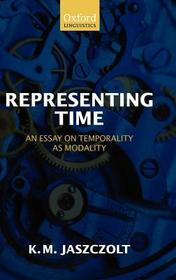
Representing Time
An Essay on Temporality as Modality
-
10% KEDVEZMÉNY?
- A kedvezmény csak az 'Értesítés a kedvenc témákról' hírlevelünk címzettjeinek rendeléseire érvényes.
- Kiadói listaár GBP 46.99
-
22 449 Ft (21 380 Ft + 5% áfa)
Az ár azért becsült, mert a rendelés pillanatában nem lehet pontosan tudni, hogy a beérkezéskor milyen lesz a forint árfolyama az adott termék eredeti devizájához képest. Ha a forint romlana, kissé többet, ha javulna, kissé kevesebbet kell majd fizetnie.
- Kedvezmény(ek) 10% (cc. 2 245 Ft off)
- Kedvezményes ár 20 204 Ft (19 242 Ft + 5% áfa)
Iratkozzon fel most és részesüljön kedvezőbb árainkból!
Feliratkozom
22 449 Ft

Beszerezhetőség
Megrendelésre a kiadó utánnyomja a könyvet. Rendelhető, de a szokásosnál kicsit lassabban érkezik meg.
Why don't you give exact delivery time?
A beszerzés időigényét az eddigi tapasztalatokra alapozva adjuk meg. Azért becsült, mert a terméket külföldről hozzuk be, így a kiadó kiszolgálásának pillanatnyi gyorsaságától is függ. A megadottnál gyorsabb és lassabb szállítás is elképzelhető, de mindent megteszünk, hogy Ön a lehető leghamarabb jusson hozzá a termékhez.
A termék adatai:
- Kiadó OUP Oxford
- Megjelenés dátuma 2009. február 26.
- ISBN 9780199214433
- Kötéstípus Keménykötés
- Terjedelem208 oldal
- Méret 241x162x17 mm
- Súly 470 g
- Nyelv angol
- Illusztrációk Line drawings 0
Kategóriák
Rövid leírás:
This book offers a new approach to the representation of meaning of temporally-located utterances and discourses. Temporality, the author suggests, should be taken to mean degrees of certainty, understood in turn as degrees of acceptability concerning the eventuality referred to in the speaker's utterance.
TöbbHosszú leírás:
Thinking and speaking about time is ridden with puzzles and paradoxes. How do human beings conceptualize time? Why, for example, does the availability of tense vary in different languages? How do the lines of information from tense, aspect, temporal adverbs, and context interact in the mind? Does time describe events? If real time does not flow, where do the concepts of the past, present and future come from? Are they basic concepts or are they composed out of more primitive constituents? And, finally, what is the semantics of expressions with temporal reference? This book offers a new approach to the representation of meaning of temporally-located utterances and discourses. Temporality, the author suggests, should be taken to mean degrees of certainty, understood in turn as degrees of acceptability concerning the eventuality referred to in the speaker's utterance. She presents theoretical arguments and empirical evidence from Indo-European and non-Indo-European languages to show that speakers represent the past, present, and future as degrees of epistemic modality. She argues that temporality can be subsumed under the general label of acceptability or attitude and, rather like the semantic category of evidentiality, founded on the strength of evidence. In the approach she develops, modality provides basic conceptual building blocks for the concept of time and at the same time semantic building blocks for representing temporal expressions in her framework of Default Semantics. Dr Jaszczolt sets the results of her research in the context of linguistic and philosophical work in semantics and pragmatics.
TöbbTartalomjegyzék:
Introduction: Thinking About Time and Living in Time
Real Time and the Concept of Time
Time as Modality
Semantic Representation of Time: A Preamble
Time in Default Semantics
Conclusion: 'Looking Forward' Into the Future
References
Index

