

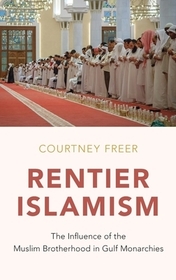
Rentier Islamism
The Influence of the Muslim Brotherhood in Gulf Monarchies
-
10% KEDVEZMÉNY?
- A kedvezmény csak az 'Értesítés a kedvenc témákról' hírlevelünk címzettjeinek rendeléseire érvényes.
- Kiadói listaár GBP 93.00
-
41 989 Ft (39 990 Ft + 5% áfa)
Az ár azért becsült, mert a rendelés pillanatában nem lehet pontosan tudni, hogy a beérkezéskor milyen lesz a forint árfolyama az adott termék eredeti devizájához képest. Ha a forint romlana, kissé többet, ha javulna, kissé kevesebbet kell majd fizetnie.
- Kedvezmény(ek) 10% (kb. 4 198 Ft)
- Kedvezményes ár 37 791 Ft (35 991 Ft + 5% áfa)
Iratkozzon fel most és részesüljön kedvezőbb árainkból!
Feliratkozom
41 989 Ft

Beszerezhetőség
Megrendelésre a kiadó utánnyomja a könyvet. Rendelhető, de a szokásosnál kicsit lassabban érkezik meg.
Why don't you give exact delivery time?
A beszerzés időigényét az eddigi tapasztalatokra alapozva adjuk meg. Azért becsült, mert a terméket külföldről hozzuk be, így a kiadó kiszolgálásának pillanatnyi gyorsaságától is függ. A megadottnál gyorsabb és lassabb szállítás is elképzelhető, de mindent megteszünk, hogy Ön a lehető leghamarabb jusson hozzá a termékhez.
A termék adatai:
- Kiadó OUP USA
- Megjelenés dátuma 2018. május 3.
- ISBN 9780190861995
- Kötéstípus Keménykötés
- Terjedelem296 oldal
- Méret 157x236x22 mm
- Súly 794 g
- Nyelv angol 0
Kategóriák
Rövid leírás:
While scholars have long looked at the role of political Islam in the Middle East, it has been assumed that domestic politics in the wealthy monarchical states of the Arabian Gulf, so-called "rentier states" where taxes are very low and oil wealth subsidizes the needs of citizens, are largely unaffected by such movements. Using contemporary history and original empirical research, Courtney Freer updates traditional rentier state theory and argues that political Islam serves as a prominent voice and tool to promote more strictly political, and often populist or reformist, views supported by many Gulf citizens.
TöbbHosszú leírás:
While scholars have long looked at the role of political Islam in the Middle East, it has been assumed that domestic politics in the wealthy monarchical states of the Arabian Gulf, so-called "rentier states" where taxes are very low and oil wealth subsidizes the needs of citizens, are largely unaffected by such movements. However, the long accepted rentier theory has been shortsighted in overlooking the socio-political role played by Muslim Brotherhood affiliates in the super-rentiers of Kuwait, Qatar, and the United Arab Emirates. While rentier state theory assumes that citizens of such states will form opposition blocs only when their stake in rent income is threatened, this book demonstrates that ideology, rather than rent, have motivated the formation of independent Islamist movements in the wealthiest states of the region.
In the monarchical systems of Qatar and the UAE, Islamist groups do not have the opportunity to compete for power and therefore cannot use the ballot box to gain popularity or influence political life, as they do elsewhere in the Middle East. But, as this book points out, the division between the social and political sectors is often blurred in the socially conservative states of the Gulf, as political actors operate through channels that are not institutionalized. Simply because politics is underinstitutionalized in such states does not mean that it is underdeveloped; the informal realm holds considerable political capital. As such, the book argues that Brotherhood movements have managed to use the links between the social (i.e. informal personal networks) and political (i.e. government institutions) to gain influence in policymaking in such states.Using contemporary history and original empirical research, Courtney Freer updates traditional rentier state theory and argues that political Islam serves as a prominent voice and tool to promote more strictly political, and often populist or reformist, views supported by many Gulf citizens.
Freer's in-depth study on the Muslim Brotherhood and its influence in Qatari, Kuwaiti and Emirati politics unquestionably adds immense value to the current literature. Indeed, Rentier Islamism fills in a gap on the rise of political Islam in neglected peripheral Muslim states whilst simultaneously revising the rentier theory and adding to a wider understanding of the political intricacies of the GCC.
Tartalomjegyzék:
Introduction - Uncharted Territory: Political Islam and Rentier States
Part I: Origins
Chapter Two - No Taxation, No Representation?: Political Opposition in Rentier States and the Origins of Muslim Brotherhood Movements in the Gulf
Chapter Three - Systems of Governance and Politics of Opposition in the Super-Rentiers
Part II: Rise and Fall
Chapter Four - Education and Influence: Origins of Rentier Islamism
Chapter Five - Politicians or Preachers?: The Development of Rentier Islamist Agendas in a Post-Arab Nationalist Era
Part III: Modern Rentier Islamism
Chapter Six - Rentier Islamism after Pan-Arabism
Chapter Seven - Challenges and Opposition in the 21st Century
Chapter Eight - Conclusion: Rentier Islamism: Explaining Ikhwan Politics in the Super-Rentiers
Notes
References
Index

