

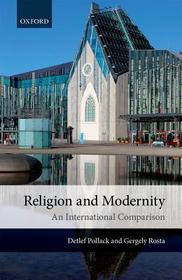
Religion and Modernity
An International Comparison
-
10% KEDVEZMÉNY?
- A kedvezmény csak az 'Értesítés a kedvenc témákról' hírlevelünk címzettjeinek rendeléseire érvényes.
- Kiadói listaár GBP 152.50
-
68 853 Ft (65 575 Ft + 5% áfa)
Az ár azért becsült, mert a rendelés pillanatában nem lehet pontosan tudni, hogy a beérkezéskor milyen lesz a forint árfolyama az adott termék eredeti devizájához képest. Ha a forint romlana, kissé többet, ha javulna, kissé kevesebbet kell majd fizetnie.
- Kedvezmény(ek) 10% (kb. 6 885 Ft)
- Kedvezményes ár 61 968 Ft (59 018 Ft + 5% áfa)
Iratkozzon fel most és részesüljön kedvezőbb árainkból!
Feliratkozom
68 853 Ft

Beszerezhetőség
Megrendelésre a kiadó utánnyomja a könyvet. Rendelhető, de a szokásosnál kicsit lassabban érkezik meg.
Why don't you give exact delivery time?
A beszerzés időigényét az eddigi tapasztalatokra alapozva adjuk meg. Azért becsült, mert a terméket külföldről hozzuk be, így a kiadó kiszolgálásának pillanatnyi gyorsaságától is függ. A megadottnál gyorsabb és lassabb szállítás is elképzelhető, de mindent megteszünk, hogy Ön a lehető leghamarabb jusson hozzá a termékhez.
A termék adatai:
- Kiadó OUP Oxford
- Megjelenés dátuma 2017. december 14.
- ISBN 9780198801665
- Kötéstípus Keménykötés
- Terjedelem506 oldal
- Méret 236x165x35 mm
- Súly 910 g
- Nyelv angol 0
Kategóriák
Rövid leírás:
The volume describes how the social significance of religion in its various facets has changed in modern societies and pinpoints the factors and conditions that have contributed to these changes.
TöbbHosszú leírás:
This is not a book that provides a new integrated theory of religious change in modern societies, but rather one that develops theoretical elements that contribute to the understanding of some contemporary religious developments. Most of the approaches in sociology of religion are prone to emphasise either processes of religious decline or of religious upswing. For example, secularization theory usually includes a couple of relevant factors--such as functional differentiation, economic affluence or social equality--in order to account for religious change. However, the result of such a theory's empirical analyses seems to be certain in advance, namely that the social relevance of religion is decreasing. In contrast, the religious market model devised by sociologists of religion in the US is inclined to detect everywhere processes of religious upsurge. Religion and Modernity: An International Comparison avoids a purely theoretically based perspective on religious changes. For this reason, Detlef Pollack and Gergely Rosta do not begin with theoretical propositions but with questions. The authors raise the question of how the social significance of religion in its various facets has changed in modern societies, and explain what factors and conditions have contributed to these changes.
this book is a jolting "must-read" for all students of religion, especially Religious Studies scholars. The broad lesson gleaned from Pollack and Rosta's multi-layered study is that while we can and should subject theories of secularization to critical examination, findings on the ground keep suggesting that modernity brings with it great challenges to the relevance and vitality of religious life.
Tartalomjegyzék:
List of Tables and Figures
Introduction
Part I: Theoretical Reflections
Reflections on the Concept of Modernity
Reflections on the Concept of Religion
Key Questions and Methodological Preliminaries
Part II: Religious Decline in Western Europe?
Between Dechurchification and Religious Persistence: West Germany
A Stronghold of Catholicism: Italy
Religion in Free Fall: The Netherlands
Part III: Religious Renaissance in Eastern Europe?
Russia: Return of Religion
East Germany: No Signs of a Turnaround
Poland: Unexpected Vitality after the Fall of Communism
Part IV: Religious Change outside Europe: Three Case Studies
Religion and Religiosity in the US: A Contrast Case to Europe?
South Korea: The Simultaneity of Modernization and Christianization
Charismatic, Pentecostal, and Evangelical Movements in Europe, the US and Brazil
Part V: Systematic Perspectives
Macro- and Microsociological Explanations for Differences between Countries
Patterns and Determinants of Religious Change in the Modern Period: Towards a Multi-Paradigmatic Theory
Bibliography

