

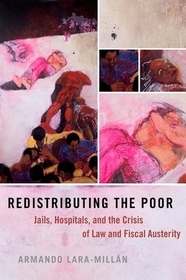
Redistributing the Poor
Jails, Hospitals, and the Crisis of Law and Fiscal Austerity
-
10% KEDVEZMÉNY?
- A kedvezmény csak az 'Értesítés a kedvenc témákról' hírlevelünk címzettjeinek rendeléseire érvényes.
- Kiadói listaár GBP 26.99
-
12 185 Ft (11 605 Ft + 5% áfa)
Az ár azért becsült, mert a rendelés pillanatában nem lehet pontosan tudni, hogy a beérkezéskor milyen lesz a forint árfolyama az adott termék eredeti devizájához képest. Ha a forint romlana, kissé többet, ha javulna, kissé kevesebbet kell majd fizetnie.
- Kedvezmény(ek) 10% (cc. 1 219 Ft off)
- Kedvezményes ár 10 967 Ft (10 445 Ft + 5% áfa)
Iratkozzon fel most és részesüljön kedvezőbb árainkból!
Feliratkozom
12 185 Ft

Beszerezhetőség
Becsült beszerzési idő: A Prosperónál jelenleg nincsen raktáron, de a kiadónál igen. Beszerzés kb. 3-5 hét..
A Prosperónál jelenleg nincsen raktáron.
Why don't you give exact delivery time?
A beszerzés időigényét az eddigi tapasztalatokra alapozva adjuk meg. Azért becsült, mert a terméket külföldről hozzuk be, így a kiadó kiszolgálásának pillanatnyi gyorsaságától is függ. A megadottnál gyorsabb és lassabb szállítás is elképzelhető, de mindent megteszünk, hogy Ön a lehető leghamarabb jusson hozzá a termékhez.
A termék adatai:
- Kiadó OUP USA
- Megjelenés dátuma 2021. augusztus 26.
- ISBN 9780197507902
- Kötéstípus Puhakötés
- Terjedelem254 oldal
- Méret 231x155x20 mm
- Súly 386 g
- Nyelv angol
- Illusztrációk 4 b/W halftones; 2 b/w line drawings 132
Kategóriák
Rövid leírás:
In Redistributing the Poor, ethnographer and historical sociologist Armando Lara-Mill--n takes us into the day-to-day operations of running the largest hospital and jail system in the world. He shows how journalists, academics, and policy makers have drastically misunderstood the rise mental illness in jails as well as the decline of public hospitals in America. Lara-Mill--n offers a new way to think about how the government makes unsolvable social problems disappear on paper and perpetuates an endless cycle of social suffering.
TöbbHosszú leírás:
Whenever the topic of large jails and public hospitals in urban America is raised, a single idea comes to mind. It is widely believed that because we as a society have dis-invested from public health, the sick and poor now find themselves within the purview of criminal justice institutions. In Redistributing the Poor, ethnographer and historical sociologist Armando Lara-Mill--n takes us into the day-to-day operations of running the largest hospital and jail system in the world and argues that such received wisdom is a drastic mischaracterization of the way that states govern urban poverty at the turn of the 21st century. Rather than focus on our underinvestment of health and overinvestment of criminal justice, his idea of "redistributing the poor" draws attention to how state agencies circulate people between different institutional spaces in such a way that generates revenue for some agencies, cuts costs for others, and projects illusions that services have been legally rendered. By centering the state's use of redistribution, Lara-Mill--n shows how certain forms of social suffering-the premature death of mainly poor, people of color-are not a result of the state's failure to act, but instead the necessary outcome of so-called successful policy.
... there is much to like about the book as written. It is an intriguing read, theoretically ambitious, and seems likely to spur additional creative research that pushes and tests its claims.
Tartalomjegyzék:
Preface
Introduction
Part One: The Expansion of Medicine in Large Urban Jail
Chapter 1: Summoning the Sick and Violent into Jail.
Chapter 2: The Medicalization of the Los Angeles County Jail System
Part Two: The Restriction of Medicine in Large Public Hospitals
Chapter 3: Opioids, Observation, and Restricting Access in the Public Emergency Room
Chapter 4: Building a Public Hospital Everyone Knows is Too Small
Conclusion: Towards the Administrative Disappearing of Social Suffering.
Appendix: Historically Embedded Ethnography.
References
Endnotes

