

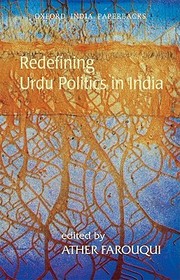
Redefining Urdu Politics in India
-
10% KEDVEZMÉNY?
- A kedvezmény csak az 'Értesítés a kedvenc témákról' hírlevelünk címzettjeinek rendeléseire érvényes.
- Kiadói listaár GBP 13.99
-
6 683 Ft (6 365 Ft + 5% áfa)
Az ár azért becsült, mert a rendelés pillanatában nem lehet pontosan tudni, hogy a beérkezéskor milyen lesz a forint árfolyama az adott termék eredeti devizájához képest. Ha a forint romlana, kissé többet, ha javulna, kissé kevesebbet kell majd fizetnie.
- Kedvezmény(ek) 10% (cc. 668 Ft off)
- Kedvezményes ár 6 015 Ft (5 729 Ft + 5% áfa)
Iratkozzon fel most és részesüljön kedvezőbb árainkból!
Feliratkozom
6 683 Ft

Beszerezhetőség
A kiadónál véglegesen elfogyott, nem rendelhető. Érdemes újra keresni a címmel, hátha van újabb kiadás.
Why don't you give exact delivery time?
A beszerzés időigényét az eddigi tapasztalatokra alapozva adjuk meg. Azért becsült, mert a terméket külföldről hozzuk be, így a kiadó kiszolgálásának pillanatnyi gyorsaságától is függ. A megadottnál gyorsabb és lassabb szállítás is elképzelhető, de mindent megteszünk, hogy Ön a lehető leghamarabb jusson hozzá a termékhez.
A termék adatai:
- Kiadó OUP India
- Megjelenés dátuma 2010. november 25.
- ISBN 9780198068464
- Kötéstípus Puhakötés
- Terjedelem344 oldal
- Méret 218x140x20 mm
- Súly 352 g
- Nyelv angol 0
Kategóriák
Hosszú leírás:
This seminal volume of essays on the status of the Urdu language since partition examines the problems faced by Urdu and the future of its survival as a functional language in India. It forwards the argument that this once-secular language has now been denigrated to only the Muslim population-it survives merely as a medium of religious instruction in madrasas. This has brought the functionality of the language in the common Indian civic space into question and has
given it communal overtones. These essays, by seventeen renowned Urdu littérateurs, speak against such reductionism. They look forward to the integration of Urdu into the educational curriculum as a Modern Indian Language and provide workable solutions for the same. This would also pave the way for a
better assimilation of the minority Muslims into the mainstream fabric of India, by promoting a more liberal and modern outlook in the community. The essays are a significant contribution towards giving Urdu its rightful place alongside other regional Indian languages and the dissemination of education to all sections of the Indian Muslim community.
Tartalomjegyzék:
Preface (Salman Khurshid); Acknowledgements; Introduction to the Paperback Edition (Ather Farouqui); Introduction (Ather Farouqui); I: Contextualizing Urdu: 1. Urdu: Between Rights and the Nation (Pratap Bhanu Mehta); 2. Language, Legitimation, and the Identity Status of Urdu and Muslims (Yogendra Singh); 3. Urdu in India in the Twenty-first Century (Barbara D. Metcalf); 4. Strategies for the Survival of Formerly Dominant Languages (With Special Reference to Urdu)
(Theodore P. Wright, Jr); II: Urdu and Identity Politics: 5. Madrasas and the Making of Muslim Identity (Arjumand Ara); 6. The Communalization and Disintegration of Urdu in Anita Desai's In Custody (Amina Yaqin); 7. The Destiny of Urdu in Independent India: Language and Muslim Identity (Daniela Bredi);
8. Whither Urdu? Language, Community, and Power in India Today (Kelly Pemberton); III: Civic Space, Education, and Urdu: 9. A Trinity without a Church: Urdu Language, Urdu Education in India, and Muslim Indians (Syed Shahabuddin); 10. Urdu Education in India: An Overview (Ather Farouqui); 11. A Foreigner's Reflections on the Status of Urdu and Urdu Education in India (Christina Oesterheld); 12. The Wardha Scheme of Basic Education and the Urdu Medium (Kerrin Gräfin von Schwerin); 13. Urdu
in India: Its Present State, and the Way Forward (Hasan Abdullah); 14. Living with Urdu, Living without Urdu (J.S. Gandhi); IV: Minority Language and Community-Legal Concerns: 15. Education for Linguistic Minorities: The Legal Framework (Fali S. Nariman); 16. Minorities in the Twenty-first Century (Soli
J. Sorabjee); 17. Legal Aspects of Minority Languages (Yogesh Tyagi); Appendix 1: Delhi Urdu Conference; Appendix 2: Valedictory Address; Glossary; Notes on Contributors; Index

