

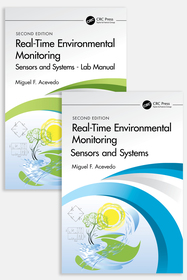
Real-Time Environmental Monitoring
Sensors and Systems - Textbook and Lab Manual
-
10% KEDVEZMÉNY?
- Kiadói listaár GBP 157.99
-
71 332 Ft (67 935 Ft + 5% áfa)
Az ár azért becsült, mert a rendelés pillanatában nem lehet pontosan tudni, hogy a beérkezéskor milyen lesz a forint árfolyama az adott termék eredeti devizájához képest. Ha a forint romlana, kissé többet, ha javulna, kissé kevesebbet kell majd fizetnie.
- Kedvezmény(ek) 10% (cc. 7 133 Ft off)
- Kedvezményes ár 64 199 Ft (61 142 Ft + 5% áfa)
64 199 Ft

Beszerezhetőség
Becsült beszerzési idő: A Prosperónál jelenleg nincsen raktáron, de a kiadónál igen. Beszerzés kb. 3-5 hét..
A Prosperónál jelenleg nincsen raktáron.
Why don't you give exact delivery time?
A beszerzés időigényét az eddigi tapasztalatokra alapozva adjuk meg. Azért becsült, mert a terméket külföldről hozzuk be, így a kiadó kiszolgálásának pillanatnyi gyorsaságától is függ. A megadottnál gyorsabb és lassabb szállítás is elképzelhető, de mindent megteszünk, hogy Ön a lehető leghamarabb jusson hozzá a termékhez.
A termék adatai:
- Kiadás sorszáma 2
- Kiadó CRC Press
- Megjelenés dátuma 2023. december 19.
- ISBN 9781032012667
- Kötéstípus Keménykötés
- Terjedelem720 oldal
- Méret 254x178 mm
- Súly 1490 g
- Nyelv angol
- Illusztrációk 639 Illustrations, black & white; 24 Illustrations, color; 213 Halftones, black & white; 3 Halftones, color; 426 Line drawings, black & white; 21 Line drawings, color; 24 Tables, black & white 447
Kategóriák
Rövid leírás:
This textbook and lab manual introduce engineering students to the fundamentals and applications of real-time environmental monitoring based on electronic sensors, instruments, systems, and software that allow continuous and long-term ecological and environmental data collection. The second edition includes state-of-the-art sensor technology.
TöbbHosszú leírás:
Both the textbook and lab manual introduce engineering students to the fundamentals and applications of real-time environmental monitoring based on electronic sensors, instruments, systems, and software that allow continuous, long-term ecological and environmental data collection. Tested in classrooms by the author, the second edition includes applications with state-of-the-art sensor technology and programs such as R, Python, Arduino, and SQL. Written to help both students and instructors in engineering better understand how to use and design a variety of sensors and build systems and databases when monitoring different environments such as soil, water, and air.
Features
- Emphasizes real-time monitoring as an emerging area for environmental assessment and compliance and covers the fundamentals on how to develop sensors and systems.
- Includes 14 lab guides that parallel the theory developed in 14 chapters in the textbook.
- Uses a practical and hands-on approach with low-cost devices and includes applications to many environmental and ecological systems
- A valuable guide for students and practitioners worldwide engaged in efforts to develop, employ, and maintain environmental monitors.
- Provides theoretical knowledge along with exercises and problems based on author’s 40 years of academic experience
Designed for students in upper-level undergraduate or graduate programs, taking courses in civil and environmental engineering, electrical engineering, mechanical engineering, geosciences, and environmental sciences, as well as professionals in environmental services, researchers in engineering, academics in engineering.
TöbbTartalomjegyzék:
Textbook
1. Principles of Environmental Monitoring 2. Programming and Single Board Computers 3. Sensors and Transducers: Basic Circuits 4. Bridge Circuits, Dynamic Specifications, and Signal Conditioning 5. Dataloggers and Sensor Networks 6. Wireless Technologies: Telemetry and Wireless Sensor Networks 7. Electric Power and Environmental Monitoring 8. Remote Monitoring of the Environment 9. Probability, Statistics, and Machine Learning 10. Databases and Geographic Information Systems (GIS) 11. Atmospheric Monitoring 12. Hydrology, Hydrodynamics, Water Quality, and Aquatic Ecosystems 13. Terrestrial Ecosystems 14. Wildlife Monitoring
Lab Manual
1. Introduction to R and Statistical Analysis 2. Programming and Single Board Computers 3. Sensors and Transducers: Thermistors and Voltage Divider Transducer 4. Bridge Circuits and Signal Conditioning 5. Dataloggers and Serial Interface Examples 6. Wireless: Radio Links for Telemetry and Wireless Sensor Networks 7. Environmental Monitoring and Electrical Power 8. Remote Sensing with R 9. Probability, Statistics. and Machine Learning 10. Databases and Geographic Information Systems (GIS) 11. Atmospheric Monitoring 12. Water Monitoring 13. Terrestrial Ecosystems 14. Wildlife Monitoring

