

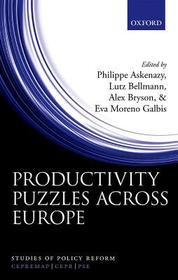
Productivity Puzzles Across Europe
Sorozatcím: Studies of Policy Reform;
-
10% KEDVEZMÉNY?
- A kedvezmény csak az 'Értesítés a kedvenc témákról' hírlevelünk címzettjeinek rendeléseire érvényes.
- Kiadói listaár GBP 87.00
-
39 280 Ft (37 410 Ft + 5% áfa)
Az ár azért becsült, mert a rendelés pillanatában nem lehet pontosan tudni, hogy a beérkezéskor milyen lesz a forint árfolyama az adott termék eredeti devizájához képest. Ha a forint romlana, kissé többet, ha javulna, kissé kevesebbet kell majd fizetnie.
- Kedvezmény(ek) 10% (kb. 3 928 Ft)
- Kedvezményes ár 35 352 Ft (33 669 Ft + 5% áfa)
Iratkozzon fel most és részesüljön kedvezőbb árainkból!
Feliratkozom
39 280 Ft

Beszerezhetőség
Megrendelésre a kiadó utánnyomja a könyvet. Rendelhető, de a szokásosnál kicsit lassabban érkezik meg.
Why don't you give exact delivery time?
A beszerzés időigényét az eddigi tapasztalatokra alapozva adjuk meg. Azért becsült, mert a terméket külföldről hozzuk be, így a kiadó kiszolgálásának pillanatnyi gyorsaságától is függ. A megadottnál gyorsabb és lassabb szállítás is elképzelhető, de mindent megteszünk, hogy Ön a lehető leghamarabb jusson hozzá a termékhez.
A termék adatai:
- Kiadó OUP Oxford
- Megjelenés dátuma 2016. szeptember 22.
- ISBN 9780198786160
- Kötéstípus Keménykötés
- Terjedelem338 oldal
- Méret 222x149x23 mm
- Súly 534 g
- Nyelv angol
- Illusztrációk Figures and Tables 0
Kategóriák
Rövid leírás:
A volume on labour productivity in Europe in the aftermath of the 2008 financial crisis. It provides rationales for recent productivity trends in France, the UK, Germany, and Spain, and analyses policy responses to the crisis and how these have affected post-recession outcomes.
TöbbHosszú leírás:
The 2008 financial crisis put an end to an era of sustained economic growth in Europe. The size of the shock differed across European countries and affected economies in different ways. Yet despite this heterogeneity, most European countries suffered a prolonged period of economic slowdown which raised concerns about the risk of a secular stagnation in Europe. This book focuses on labour productivity in Europe, one of the main drivers of growth and prosperity. Although productivity trends became the focus of policy interest in the immediate aftermath of the recession in the UK, 'productivity puzzles' received much less attention in the rest of Europe. These 'puzzles', which are apparent to greater or lesser extents in most European economies, centre on the marked decline in labour productivity growth which occurred with the on-set of recession. They are puzzles because, in neo-classical economics, firms respond to demand shocks by laying off workers, thus maintaining labour productivity and limiting growth in unit labour costs. Yet this didn't happen in this recession - at least, not to the same extent as in previous recessions, except in Spain.
This book brings together contributions from leading European economists who analyse production models and macroeconomic policies, with specific focus on European countries that represent around 60% of the EU GDP. Chapters on France, Germany, the UK, and Spain provide new evidences at the firm/workplace level, and stress the role of transitory labour market mechanisms
Tartalomjegyzék:
Introduction
Europe's Productivity Slowdown Revisited: A Comparative Perspective to the United States
Is Secular Stagnation the Future for Europe?
Understanding Productivity and Employment in a Fragmenting Economy: The Global Value Chain Approach
Exploring the French Productivity Puzzle
The UK's Productivity Puzzle
Discussion of the French and British Conundrums
The German Labour Market Puzzle in the Great Recession
The Spanish Productivity Puzzle
Comments on Two Polar Puzzles: Germany and Spain

