

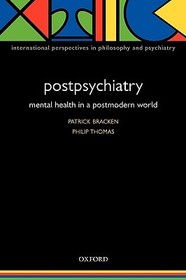
Postpsychiatry
Mental health in a postmodern world
Sorozatcím: International Perspectives in Philosophy & Psychiatry;
-
10% KEDVEZMÉNY?
- A kedvezmény csak az 'Értesítés a kedvenc témákról' hírlevelünk címzettjeinek rendeléseire érvényes.
- Kiadói listaár GBP 81.00
-
38 697 Ft (36 855 Ft + 5% áfa)
Az ár azért becsült, mert a rendelés pillanatában nem lehet pontosan tudni, hogy a beérkezéskor milyen lesz a forint árfolyama az adott termék eredeti devizájához képest. Ha a forint romlana, kissé többet, ha javulna, kissé kevesebbet kell majd fizetnie.
- Kedvezmény(ek) 10% (cc. 3 870 Ft off)
- Kedvezményes ár 34 828 Ft (33 170 Ft + 5% áfa)
Iratkozzon fel most és részesüljön kedvezőbb árainkból!
Feliratkozom
38 697 Ft

Beszerezhetőség
Megrendelésre a kiadó utánnyomja a könyvet. Rendelhető, de a szokásosnál kicsit lassabban érkezik meg.
Why don't you give exact delivery time?
A beszerzés időigényét az eddigi tapasztalatokra alapozva adjuk meg. Azért becsült, mert a terméket külföldről hozzuk be, így a kiadó kiszolgálásának pillanatnyi gyorsaságától is függ. A megadottnál gyorsabb és lassabb szállítás is elképzelhető, de mindent megteszünk, hogy Ön a lehető leghamarabb jusson hozzá a termékhez.
A termék adatai:
- Kiadó OUP Oxford
- Megjelenés dátuma 2005. december 22.
- ISBN 9780198526094
- Kötéstípus Puhakötés
- Terjedelem312 oldal
- Méret 233x156x18 mm
- Súly 494 g
- Nyelv angol
- Illusztrációk Tables and line illustrations 0
Kategóriák
Rövid leírás:
Postpsychiatry shows how recent developments in philosophy and ethics can help us to clarify some of the dilemmas and conflicts around different understandings of madness. Throughout, the authors examine the conflicting ways in which politicians, academics, and mental health professionals appear to understand madness, and contrast this with voices and experiences that are usually excluded - those of the people who use mental health services. Drawing on evidence from psychiatric service users and survivors, the humanities and anthropology, it points out a brave new direction for mental health practice.
TöbbHosszú leírás:
How are we to make sense of madness and psychosis? For most of us the words conjure up images from television and newspapers of seemingly random, meaningless violence. It is something to be feared, something to be left to the experts. But is madness best thought of as a medical condition? Psychiatrists and the drug industry maintain that psychoses are brain disorders amenable to treatment with drugs, but is this actually so? There is no convincing evidence that the brain is disordered in psychosis, yet governments across the world are investing huge sums of money on mental health services that take for granted the idea that psychosis is an illness to be treated with medication. Although some people who use mental health services find medication helpful, many do not, and resist the idea that their experiences are symptoms of illnesses like schizophrenia. Consequently they are forced into having treatment against their wishes. So, how do we make sense of this situation?
Postpsychiatry addresses these questions. It involves an attempt to rethink some of the fundamental assumptions of mental health work, showing how recent developments in philosophy and ethics can help us to clarify some of the dilemmas and conflicts around different understandings of madness. Throughout, the authors examine the conflicting ways in which politicians, academics, and mental health professionals appear to understand madness, and contrast this with voices and experiences that are usually excluded - those of the people who use mental health services. They then examine the power of psychiatry to shape how we understand ourselves and our emotions, before considering some of the basic limitations of psychiatry as science to make madness meaningful. In the final section of the book they draw on evidence from service users and survivors, the humanities and anthropology, to point out a new direction for mental health practice. This new direction emphasises the importance of cultural contexts in understanding madness, placing ethics before technology in responding to madness, and minimising 'therapeutic' coercion.
... this book is very successful at making you think about your clinical practice... It challenged my thinking and I found myself nodding my head to some of the ideas presented, but totally disagreeing with others. If the aim of this book is to challenge status quo thinking then it does this very well and for this alone is highly recommended.
Tartalomjegyzék:
Introduction: 'The times they are a-changin'
Doing their best
Values, evidence, conflict
What counts as evidence?
The miracle drug
The battle for acceptance: defining the relationship between medicine and the world of madness and distress
The ring
Foregrounding contexts: what kinds of understanding are appropriate in the world of mental illness?
Losing Peter
Mind, language and meaning
Beetles
Ethics before technology - is 'treatment' the best way to think about mental health work?
Narrative and the ethics of representation
Meaning and recovery
Citizenship and the politics of identity
Are you local? Responding to the challenge of globalisation in mental health
The veil

