

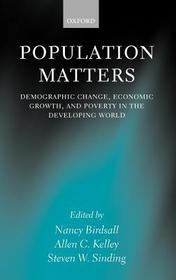
Population Matters
Demographic Change, Economic Growth, and Poverty in the Developing World
-
10% KEDVEZMÉNY?
- A kedvezmény csak az 'Értesítés a kedvenc témákról' hírlevelünk címzettjeinek rendeléseire érvényes.
- Kiadói listaár GBP 66.00
-
29 799 Ft (28 380 Ft + 5% áfa)
Az ár azért becsült, mert a rendelés pillanatában nem lehet pontosan tudni, hogy a beérkezéskor milyen lesz a forint árfolyama az adott termék eredeti devizájához képest. Ha a forint romlana, kissé többet, ha javulna, kissé kevesebbet kell majd fizetnie.
- Kedvezmény(ek) 10% (kb. 2 980 Ft)
- Kedvezményes ár 26 819 Ft (25 542 Ft + 5% áfa)
Iratkozzon fel most és részesüljön kedvezőbb árainkból!
Feliratkozom
29 799 Ft

Beszerezhetőség
Megrendelésre a kiadó utánnyomja a könyvet. Rendelhető, de a szokásosnál kicsit lassabban érkezik meg.
Why don't you give exact delivery time?
A beszerzés időigényét az eddigi tapasztalatokra alapozva adjuk meg. Azért becsült, mert a terméket külföldről hozzuk be, így a kiadó kiszolgálásának pillanatnyi gyorsaságától is függ. A megadottnál gyorsabb és lassabb szállítás is elképzelhető, de mindent megteszünk, hogy Ön a lehető leghamarabb jusson hozzá a termékhez.
A termék adatai:
- Kiadó OUP Oxford
- Megjelenés dátuma 2001. augusztus 30.
- ISBN 9780199244072
- Kötéstípus Keménykötés
- Terjedelem456 oldal
- Méret 236x156x40 mm
- Súly 770 g
- Nyelv angol
- Illusztrációk numerous tables and figures 0
Kategóriák
Rövid leírás:
Does rapid population growth diminish countries' economic development prospects? Do policies aimed at reducing high fertility help families escape poverty? These questions have been at the heart of policy debates since the time of Malthus, and have been particularly heated during the last half-century of explosive Third World population growth. In this carefully constructed collection of recent studies and analyses, the authors offer a nuanced, yet clear and positive answer to these questions---a refreshing step forward from the ambiguous conclusions of much of the literature of the 1970s and 1980s.
TöbbHosszú leírás:
The effect of demography on economic performance has been the subject of intense debate in economics for nearly two centuries. In recent years opinion has swung between the Malthusian views of Coale and Hoover, and the cornucopian views of Julian Simon. Unfortunately, until recently, data were too weak and analytical models too limited to provide clear insights into the relationship. As a result, economists as a group have not been clear or conclusive.
This volume, which is based on a collection of papers that heavily rely on data from the 1980s and 1990s and on new analytical approaches, sheds important new light on demographic--economic relationships, and it provides clearer policy conclusions than any recent work on the subject. In particular, evidence from developing countries throughout the world shows a pattern in recent decades that was not evident earlier: countries with higher rates of population growth have tended to see less economic growth. An analysis of the role of demography in the "Asian economic miracle" strongly suggests that changes in age structures resulting from declining fertility create a one-time "demographic gift" or window of opportunity, when the working age population has relatively few dependants, of either young or old age, to support. Countries which recognize and seize on this opportunity can, as the Asian tigers did, realize healthy bursts in economic output. But such results are by no means assured: only for countries with otherwise sound economic policies will the window of opportunity yield such dramatic results. Finally, several of the studies demonstrate the likelihood of a causal relationship between high fertility and poverty. While the direction of causality is not always clear and very likely is reciprocal (poverty contributes to high fertility and high fertility reinforces poverty), the studies support the view that lower fertility at the country level helps create a path out of poverty for many families.
Population Matters represents an important further step in our understanding of the contribution of population change to economic performance. As such, it will be a useful volume for policymakers both in developing countries and in international development agencies.
Provides a very valuable discussion, with detailed references, of the knotty methodological issues inherent in the demography-development debate. . . . Anyone concerned with how population change affects the development prospects of poor countries will profit from reading these essays.
Tartalomjegyzék:
I. Setting the Stage
How and Why Population Matters: New Findings, New Issues
The Population Debate in Historical Perspective: Revisionism Revised
Dependency Burdens in the Developing World
II. Population Change and the Economy
Economic and Demographic Change: A Synthesis of Models, Findings, and Perspectives
Demographic Change, Economic Growth and Inequality
Saving, Wealth, and Population
Cumulative Causality, Economic Growth and the Demographic Transition
III. Fertility, Poverty and the Family
Population and Poverty in Households: A Review of Reviews
Demographic Transition and Poverty: Effects Via Economic Growth, Distribution, and Conversion
Inequality and the Family in Latin America
Demographic Changes and Poverty in Brazil
IV. Population, Agriculture and Natural Resources
Rural Population Growth, Agricultural Change and Natural Resource Management in Developing Countries: A Review of Hypotheses and Some Evidence from Honduras
V. Some Economics of Population Policy
Why Micro Matters
New Findings in Economics and Demography: Implications for Policies to Reduce Poverty

