

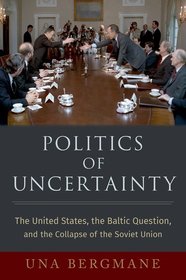
Politics of Uncertainty
The United States, the Baltic Question, and the Collapse of the Soviet Union
Sorozatcím: OXFORD STUDIES IN INTL HISTORY SERIES;
-
10% KEDVEZMÉNY?
- A kedvezmény csak az 'Értesítés a kedvenc témákról' hírlevelünk címzettjeinek rendeléseire érvényes.
- Kiadói listaár GBP 35.99
-
16 249 Ft (15 475 Ft + 5% áfa)
Az ár azért becsült, mert a rendelés pillanatában nem lehet pontosan tudni, hogy a beérkezéskor milyen lesz a forint árfolyama az adott termék eredeti devizájához képest. Ha a forint romlana, kissé többet, ha javulna, kissé kevesebbet kell majd fizetnie.
- Kedvezmény(ek) 10% (kb. 1 625 Ft)
- Kedvezményes ár 14 624 Ft (13 928 Ft + 5% áfa)
Iratkozzon fel most és részesüljön kedvezőbb árainkból!
Feliratkozom
16 249 Ft

Beszerezhetőség
Becsült beszerzési idő: A Prosperónál jelenleg nincsen raktáron, de a kiadónál igen. Beszerzés kb. 3-5 hét..
A Prosperónál jelenleg nincsen raktáron.
Why don't you give exact delivery time?
A beszerzés időigényét az eddigi tapasztalatokra alapozva adjuk meg. Azért becsült, mert a terméket külföldről hozzuk be, így a kiadó kiszolgálásának pillanatnyi gyorsaságától is függ. A megadottnál gyorsabb és lassabb szállítás is elképzelhető, de mindent megteszünk, hogy Ön a lehető leghamarabb jusson hozzá a termékhez.
A termék adatai:
- Kiadó OUP USA
- Megjelenés dátuma 2023. április 27.
- ISBN 9780197578346
- Kötéstípus Keménykötés
- Terjedelem256 oldal
- Méret 238x162x24 mm
- Súly 517 g
- Nyelv angol 352
Kategóriák
Rövid leírás:
In 1989 three Soviet republics--Estonia, Latvia, and Lithuania, known as Baltic countries--started a determined push for independence, risking to destabilize the Soviet Union and to derail international negotiations on German reunification. Politics of Uncertainty traces Soviet and American responses to Baltic claims for independence and, in doing so, sheds light on the end of the Cold War.
TöbbHosszú leírás:
In March 1990, Lithuania became the first Soviet Republic to declare its independence. Within weeks, the two other Baltic states, Estonia and Latvia, announced the beginning of a transition period toward full sovereignty. The Soviet Union, which considered the Baltic declarations illegal, harshly condemned them and imposed an economic blockade against Lithuania. Fearing an outbreak of violence in the region, the United States tried to de-escalate the crisis, pressuring all sides to engage in dialogue.
Thirty years after the Soviet collapse Politics of Uncertainty investigates the interplay between international and domestic dynamics in the Soviet disintegration process. Based on extensive multilingual archival research, this book recovers the voices of local actors in Riga, Tallinn, and Vilnius in its examination of the triangular relations between Washington, Moscow, and Baltic independence movements. Occupied and annexed by the USSR in 1940, Estonia, Latvia, and Lithuania were the first Soviet republics to push the limits of Perestroika. The Baltic problem, at first seemingly minor, increasingly gained international visibility and by 1990 risked derailing issues that mattered in the eyes of both Soviet and American leaders--the transformation of the Soviet state and transformation of the European order. The United States, which had never recognized the annexation of the Baltic states, tried to perform a highly challenging balancing act of supporting Baltic independence without jeopardizing relations with the Kremlin. Meanwhile Mikhail Gorbachev, who saw the Baltics as an integral part of the USSR, was frustrated that their secessionist tendencies distracted from the monumental opportunity for change that the Perestroika project offered to his country and the world. Meanwhile, George Bush, FranÃ
ois Mitterrand, and Helmut Kohl were exasperated that events at the margins of the Soviet empire risked destabilizing Gorbachev and souring East-West relations during negotiations over German reunification.
By focusing on the relations between those at the top of global power hierarchies and those situated at their margins, Una Bergmane underscores how the Soviet collapse was driven much more by uncertainty, domestic pressures, and last-minute decisions than by long-term strategy--while warning about the tenuous geopolitical positions of these three states that joined NATO and the European Union after breaking out of the Soviet empire.
The Soviet Union's sudden and surprising collapse continues to resonate, nowhere more so than in the Baltics. Long subjugated, sometimes pawns, and oftentimes a thorn in the side of Kremlin leaders, the region's recent past tells us much about life next to a superpower. No scholar has better brought the Baltics and the end of the Cold War into focus than Una Bergmane, whose Politics of Uncertainty is certain to set the standard for any future study of this critical geopolitical hotspot.
Tartalomjegyzék:
Acknowledgments
Introduction
Chapter 1: The Origins of the Baltic Question
Chapter 2: "Have you not noticed our absence?" The Baltic Question during the Annus Mirabilis of 1989
Chapter 3: Building a New World Order? The Lithuanian Crisis of Spring 1990
Chapter 4: The End of Perestroika? The Baltic Quest for Visibility and the Soviet Crackdown
Chapter 5: The Rise of Republics, the Fall of the Center: The Baltic Exception and the Collapse of the USSR
Conclusion
Notes
Bibliography
Index

