

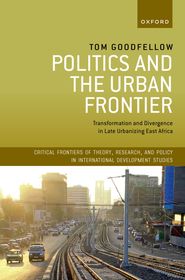
Politics and the Urban Frontier
Transformation and Divergence in Late Urbanizing East Africa
Sorozatcím: Critical Frontiers of Theory, Research, and Policy in International Development Studies;
-
10% KEDVEZMÉNY?
- A kedvezmény csak az 'Értesítés a kedvenc témákról' hírlevelünk címzettjeinek rendeléseire érvényes.
- Kiadói listaár GBP 30.00
-
14 332 Ft (13 650 Ft + 5% áfa)
Az ár azért becsült, mert a rendelés pillanatában nem lehet pontosan tudni, hogy a beérkezéskor milyen lesz a forint árfolyama az adott termék eredeti devizájához képest. Ha a forint romlana, kissé többet, ha javulna, kissé kevesebbet kell majd fizetnie.
- Kedvezmény(ek) 10% (cc. 1 433 Ft off)
- Kedvezményes ár 12 899 Ft (12 285 Ft + 5% áfa)
Iratkozzon fel most és részesüljön kedvezőbb árainkból!
Feliratkozom
14 332 Ft

Beszerezhetőség
Becsült beszerzési idő: A Prosperónál jelenleg nincsen raktáron, de a kiadónál igen. Beszerzés kb. 3-5 hét..
A Prosperónál jelenleg nincsen raktáron.
Why don't you give exact delivery time?
A beszerzés időigényét az eddigi tapasztalatokra alapozva adjuk meg. Azért becsült, mert a terméket külföldről hozzuk be, így a kiadó kiszolgálásának pillanatnyi gyorsaságától is függ. A megadottnál gyorsabb és lassabb szállítás is elképzelhető, de mindent megteszünk, hogy Ön a lehető leghamarabb jusson hozzá a termékhez.
A termék adatai:
- Kiadó OUP Oxford
- Megjelenés dátuma 2024. augusztus 22.
- ISBN 9780198916383
- Kötéstípus Puhakötés
- Terjedelem352 oldal
- Méret 234x156x19 mm
- Súly 534 g
- Nyelv angol 548
Kategóriák
Rövid leírás:
This book offers the first full-length comparative analysis of urban development trajectories in Eastern Africa and the political dynamics that underpin them. It offers a multi-scalar, historically-grounded, and interdisciplinary analysis of the urban transformations unfolding in the world's most dynamic crucible of urban change.
TöbbHosszú leírás:
Despite the rise of global technocratic ideals of city-making, cities around the world are not merging into indistinguishable duplicates of one another. In fact, as the world urbanizes, urban formations remain diverse in their socioeconomic and spatial characteristics, with varying potential to foster economic development and social justice. In this book, Tom Goodfellow argues that these differences are primarily rooted in politics, and if we continue to view cities as economic and technological projects to be managed rather than terrains of political bargaining and contestation, the quest for better urban futures is doomed to fail. Dominant critical approaches to urban development tend to explain difference with reference to the variegated impacts of neoliberal regulatory institutions. This, however, neglects the multiple ways in which the wider politics of capital accumulation and distribution drive divergent forms of transformation in different urban places.
In order to unpack the politics that shapes differential urban development, this book focuses on East Africa as the global urban frontier: the least urbanized but fastest urbanizing region in the world. Drawing on a decade of research spanning three case study countries (Ethiopia, Rwanda, and Uganda), Politics and the Urban Frontier provides the first sustained, book-length comparative analysis of urban development trajectories in Eastern Africa and the political dynamics that underpin them. Through a focus on infrastructure investment, urban propertyscapes, street-level trading economies, and urban political protest, it offers a multi-scalar, historically-grounded, and interdisciplinary analysis of the urban transformations unfolding in the world's most dynamic crucible of urban change.
In this highly original analysis, the global condition of late urbanization forms the basis for retheorizing urban politics, starting in East Africa. This analysis not only sheds light on the complex urbanization processes of this region, but generates rich concepts which urbanists in other contexts will be able to draw on.
Tartalomjegyzék:
Part I. Urban Tectonics
East Africa and the politics of late urbanization
Transformation and divergence: Explaining contemporary urban development trajectories
Part II. Urban Foundations
The making of urban territory
The making of urban economies
Part III. Urban Currents
New urban visions and the infrastructure boom
Urban propertyscapes
Working the city: Vendors, 'untouchables', and street fugitives
The politics of noise and silence: Negotiation, mobilization, refusal
Part IV. Conclusions
Politics and the urban frontier

