

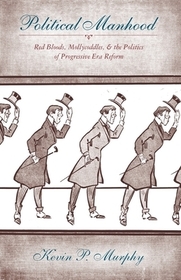
Political Manhood
Red Bloods, Mollycoddles, and the Politics of Progressive Era Reform
-
10% KEDVEZMÉNY?
- A kedvezmény csak az 'Értesítés a kedvenc témákról' hírlevelünk címzettjeinek rendeléseire érvényes.
- Kiadói listaár GBP 30.00
-
13 545 Ft (12 900 Ft + 5% áfa)
Az ár azért becsült, mert a rendelés pillanatában nem lehet pontosan tudni, hogy a beérkezéskor milyen lesz a forint árfolyama az adott termék eredeti devizájához képest. Ha a forint romlana, kissé többet, ha javulna, kissé kevesebbet kell majd fizetnie.
- Kedvezmény(ek) 10% (kb. 1 355 Ft)
- Kedvezményes ár 12 191 Ft (11 610 Ft + 5% áfa)
Iratkozzon fel most és részesüljön kedvezőbb árainkból!
Feliratkozom
13 545 Ft

Beszerezhetőség
Becsült beszerzési idő: A Prosperónál jelenleg nincsen raktáron, de a kiadónál igen. Beszerzés kb. 3-5 hét..
A Prosperónál jelenleg nincsen raktáron.
Why don't you give exact delivery time?
A beszerzés időigényét az eddigi tapasztalatokra alapozva adjuk meg. Azért becsült, mert a terméket külföldről hozzuk be, így a kiadó kiszolgálásának pillanatnyi gyorsaságától is függ. A megadottnál gyorsabb és lassabb szállítás is elképzelhető, de mindent megteszünk, hogy Ön a lehető leghamarabb jusson hozzá a termékhez.
A termék adatai:
- Kiadó Columbia University Press
- Megjelenés dátuma 2010. szeptember 3.
- ISBN 9780231129978
- Kötéstípus Puhakötés
- Terjedelem320 oldal
- Méret 228x152 mm
- Nyelv angol 0
Kategóriák
Rövid leírás:
In a 1907 lecture to Harvard undergraduates, Theodore Roosevelt claimed that colleges should never "turn out mollycoddles instead of vigorous men," warning that "the weakling and the coward are out of place in a strong and free community." A paradigm of ineffectuality and weakness, the mollycoddle was "all inner life," whereas his opposite, the "red blood," was a man of action. Kevin P. Murphy reveals how the popular ideals of American masculinity coalesced around these two distinct categories. Because of its similarity to the emergent "homosexual" type, the mollycoddle became a powerful rhetorical figure, often used to marginalize and stigmatize certain political actors.
Murphy's history follows the redefinition of manhood across a variety of classes, especially in the work of late nineteenth-century reformers who trumpeted the virility of the laboring classes. Challenging the characterization of the relationship between political "machines" and social and municipal reformers at the turn of the twentieth century, he revolutionizes our understanding of the gendered and sexual meanings attached to political and ideological positions of the Progressive Era.
TöbbHosszú leírás:
In a 1907 lecture to Harvard undergraduates, Theodore Roosevelt claimed that colleges should never "turn out mollycoddles instead of vigorous men," warning that "the weakling and the coward are out of place in a strong and free community." A paradigm of ineffectuality and weakness, the mollycoddle was "all inner life," whereas his opposite, the "red blood," was a man of action. Kevin P. Murphy reveals how the popular ideals of American masculinity coalesced around these two distinct categories. Because of its similarity to the emergent "homosexual" type, the mollycoddle became a powerful rhetorical figure, often used to marginalize and stigmatize certain political actors.
Murphy's history follows the redefinition of manhood across a variety of classes, especially in the work of late nineteenth-century reformers who trumpeted the virility of the laboring classes. Challenging the characterization of the relationship between political "machines" and social and municipal reformers at the turn of the twentieth century, he revolutionizes our understanding of the gendered and sexual meanings attached to political and ideological positions of the Progressive Era.
Több
