

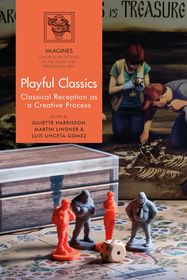
Playful Classics
Classical Reception as a Creative Process
Sorozatcím: IMAGINES – Classical Receptions in the Visual and Performing Arts;
-
20% KEDVEZMÉNY?
- A kedvezmény csak az 'Értesítés a kedvenc témákról' hírlevelünk címzettjeinek rendeléseire érvényes.
- Kiadói listaár GBP 28.99
-
13 088 Ft (12 465 Ft + 5% áfa)
Az ár azért becsült, mert a rendelés pillanatában nem lehet pontosan tudni, hogy a beérkezéskor milyen lesz a forint árfolyama az adott termék eredeti devizájához képest. Ha a forint romlana, kissé többet, ha javulna, kissé kevesebbet kell majd fizetnie.
- Kedvezmény(ek) 20% (cc. 2 618 Ft off)
- Kedvezményes ár 10 471 Ft (9 972 Ft + 5% áfa)
- A kedvezmény érvényes eddig: 2026. június 30.
Iratkozzon fel most és részesüljön kedvezőbb árainkból!
Feliratkozom
13 088 Ft

Beszerezhetőség
Még nem jelent meg, de rendelhető. A megjelenéstől számított néhány héten belül megérkezik.
Why don't you give exact delivery time?
A beszerzés időigényét az eddigi tapasztalatokra alapozva adjuk meg. Azért becsült, mert a terméket külföldről hozzuk be, így a kiadó kiszolgálásának pillanatnyi gyorsaságától is függ. A megadottnál gyorsabb és lassabb szállítás is elképzelhető, de mindent megteszünk, hogy Ön a lehető leghamarabb jusson hozzá a termékhez.
A termék adatai:
- Kiadó Bloomsbury Publishing (UK)
- Megjelenés dátuma 2026. június 25.
- ISBN 9781350418660
- Kötéstípus Puhakötés
- Terjedelem288 oldal
- Méret 234x156 mm
- Nyelv
- Illusztrációk 54 bw illus 700
Kategóriák
Rövid leírás:
Offers a wide-ranging overview of the reception of Greco-Roman antiquity as a ludic process.
TöbbHosszú leírás:
This is the first book to deal exclusively with ludic interactions with classical antiquity - an understudied research area within classical reception studies - that can shed light on current processes of construction and appropriation of the Greco-Roman world. Classical antiquity has, for many years, been sold as a product and consumed in a wide variety of forms of entertainment. As a result, games, playing and playful experiences are a privileged space for the reception of antiquity. Through the medium of games, players, performers and audiences are put into direct contact with the classical past, and encouraged to experience it in a participative, creative and subjective fashion.
The chapters in this volume, written by scholars and practitioners, cover a variety of topics and cultural artefacts including toys, board games and video games, as well as immersive experiences such as museums, theme parks and toga parties. The contributors tackle contemporary ludic practices and several papers establish a dialogue between artists and scholars, contrasting and harmonising their different approaches to the role of playfulness. Other chapters explore the educational potential of these manifestations, or their mediating role in shaping our conceptions of ancient Greece and Rome. Altogether, this edited collection is the first to offer a comprehensive overview of the ways we can play with antiquity.
Tartalomjegyzék:
"
Introduction: Thinking About Playful Classics - A Beginners' Guide, Martin Lindner (University of Gï¿1⁄2ttingen, Germany)
Section I: Toys and Games
1. Playing with Caesar and Cleopatra - Anticising Play Figures and Historical Thinking of (Young) Children, Anabelle Thurn (University of Education Freiburg, Germany)
2. Card Games and Antiquity in Spain, Antonio Duplï¿1⁄2 Ansuategui (University of the Basque Country, Spain)
3. Designing ""Archaeologists vs Treasure Hunters"" - Just Another Board Game?, Irina Vagalinska (Independent Scholar, Bulgaria) and Lyudmil Vagalinski (National Archaeological Institute and Museum, Bulgaria)
Section II: Virtual Realities
4. The Playing Field - The Study of Classical Antiquity in Video Games and the Database Project ""Paizomen"", Alexander Vandewalle (University of Antwerp and Ghent University, Belgium)
5. ""Let's Analyse Ancient Greece"" - Digital Game-based Learning and ""Assassin's Creed Odyssey"", Kai Matuszkiewicz (Marburg University, Germany) and Kai Ruffing (Kassel University, Germany)
Section III: Playing on Stage
6. Repraesentatio in Musica: Researches about Antiquity in French Baroque Music and its Impact on Today's Performance Practice, Antonius Adamske (Independent Scholar, Germany)
7. ""That's Greek to Me"" - Disco Life, Game-shows, and Queer Intimacies in Richard Move's ""Achilles' Heels"", Zoa Alonso Fernï¿1⁄2ndez (Autonomous University of Madrid, Spain)
8. Playing Classical Drama - ""Young"" Theatre Festivals and the ""Non-school"" of Ravenna, Martina Treu (IULM University, Milan) and non scuola (Independent Scholar, Italy)
Section IV: Immersive Antiquities
9. Toga parties - Ludic Re-enactments of a Lubricious Rome, Luis Unceta Gï¿1⁄2mez (Autonomous University of Madrid, Spain)
10. Curses, Mummies, and Colonial Style - Archaeology in the Theme Park, Filippo Carlï¿1⁄2-Uhink (Potsdam University, Germany) and Florian Freitag (University of Duisburg-Essen, Germany)
11. Classical Reception in Street Art Performance, Anna Socha (University of Liverpool, UK) and PichiAvo (Independent Scholar, Spain)
Section V: National Traditions
12. Forges' Vision of the Roman Conquest of the Iberian Peninsula, Pepa Castillo (La Rioja University, Spain)
13. Playing with Greek Mythology in Russian Animation, Chiara Sulprizio (Vanderbilt University, USA)
14. Playground ""WeChat"" - Western Classics in Chinese Social Media, Sven Gï¿1⁄2nther (Changchun University, China)
Coda: The Interaction of Play and Other Receptions, Juliette Harrisson (Birmingham Newman University, UK)
Notes
Bibliography
Index

