

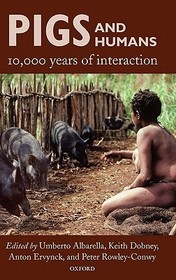
Pigs and Humans
10,000 Years of Interaction
-
10% KEDVEZMÉNY?
- A kedvezmény csak az 'Értesítés a kedvenc témákról' hírlevelünk címzettjeinek rendeléseire érvényes.
- Kiadói listaár GBP 222.50
-
100 458 Ft (95 675 Ft + 5% áfa)
Az ár azért becsült, mert a rendelés pillanatában nem lehet pontosan tudni, hogy a beérkezéskor milyen lesz a forint árfolyama az adott termék eredeti devizájához képest. Ha a forint romlana, kissé többet, ha javulna, kissé kevesebbet kell majd fizetnie.
- Kedvezmény(ek) 10% (cc. 10 046 Ft off)
- Kedvezményes ár 90 413 Ft (86 108 Ft + 5% áfa)
Iratkozzon fel most és részesüljön kedvezőbb árainkból!
Feliratkozom
100 458 Ft

Beszerezhetőség
Megrendelésre a kiadó utánnyomja a könyvet. Rendelhető, de a szokásosnál kicsit lassabban érkezik meg.
Why don't you give exact delivery time?
A beszerzés időigényét az eddigi tapasztalatokra alapozva adjuk meg. Azért becsült, mert a terméket külföldről hozzuk be, így a kiadó kiszolgálásának pillanatnyi gyorsaságától is függ. A megadottnál gyorsabb és lassabb szállítás is elképzelhető, de mindent megteszünk, hogy Ön a lehető leghamarabb jusson hozzá a termékhez.
A termék adatai:
- Kiadó OUP Oxford
- Megjelenés dátuma 2007. december 6.
- ISBN 9780199207046
- Kötéstípus Keménykötés
- Terjedelem488 oldal
- Méret 240x162x25 mm
- Súly 959 g
- Nyelv angol
- Illusztrációk 57 in-text photographs, 93 line drawings 0
Kategóriák
Rövid leírás:
A collection of essays focusing upon the role wild and domestic pigs have played in human societies around the world over the last 10,000 years. The 22 contributors cover a broad and diverse range of themes, grounded within the disciplines of archaeology, zoology, anthropology, and biology, as well as art history and history.
TöbbHosszú leírás:
Pigs are one of the most iconic but also paradoxical animals ever to have developed a relationship with humans. This relationship has been a long and varied one: from noble wild beast of the forest to mass produced farmyard animal; from a symbol of status and plenty to a widespread religious food taboo; from revered religious totem to a parodied symbol of filth and debauchery.
Pigs and Humans brings together some of the key scholars whose research is highlighting the role wild and domestic pigs have played in human societies around the world over the last 10,000 years. The 22 contributors cover a broad and diverse range of temporal, geographical, and topical themes, grounded within the disciplines of archaeology, zoology, anthropology, and biology, as well as art history and history. They explore such areas as evolution and taxonomy, domestication and husbandry, ethnography, and ritual and art, and present some of the latest theories and methodological techniques. The volume as a whole is generously illustrated and will enhance our understanding of many of the issues regarding our complex and ever changing relationship with the pig.
...a multidisciplinary approach that takes into account zoology, palaeontology, genetics, ethnography and archaeology, and researchers with these different approaches have contributed to the many authoritative chapters in this book. It has been well editied, has excellent illustrations and will be of interest and use to readers in many different disciplines.
Tartalomjegyzék:
Introduction
I. Evolution and Taxonomy
Current views on taxonomy and zoogeography of the genus Sus
Current views on Sus phylogeography and pig domestication as seen through modern mtDNA studies
The molecular basis for phenotypic changes during pig domestication
II. The History of Pig Domestication and Husbandry
The transition from wild boar to domestic pig in Eurasia, illustrated by a tooth development defect and biometrical data
Culture, ecology and pigs from the 5th to the 3rd millennium BC around the Fertile Crescent
Hunting or management? The status of Sus in the Jomon Period, Japan
Wild boar and domestic pigs in Mesolithic and Neolithic southern Scandinavia
The economic role of Sus in early human fishing communities
An investigation into the transition from forest dwelling pigs to farm animals in medieval Flanders, Belgium
III. Methodological Applications
Age estimation of wild boar based on molariform mandibular tooth development and its application to seasonality at the Mesolithic site of Ringkloster, Denmark
A statistical method for dealing with isolated teeth: ageing pig teeth from Hagoshrim, Israel
Inter-population variation in recent wild boar from Israel
A dental microwear study of pig diet and management in Iron Age, Romano-British, Anglo-Scandinavian and medieval contexts in England
The histopathology of fluorotic dental enamel in wild boar and domestic pigs
Economic and ecological reconstruction at the Classical site of Sagalassos, Turkey, using pigs' teeth
IV. Ethnographic Studies
Ethnoarchaeology of pig husbandry in Sardinia and Corsica
Traditional pig butchery by the Yali people of West Papua (Irian Jaya): an ethnographic and archaeozoological example
Pigs in the New Guinea Highlands: an ethnographic example
V. Pigs in Ritual and Art
Wild boar hunting in the Eastern Mediterranean from the 2nd to the 1st millennium BC
The pig in medieval iconography

