

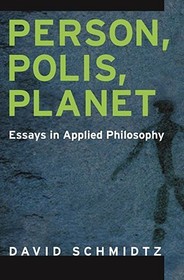
Person, Polis, Planet
Essays in Applied Philosophy
-
10% KEDVEZMÉNY?
- A kedvezmény csak az 'Értesítés a kedvenc témákról' hírlevelünk címzettjeinek rendeléseire érvényes.
- Kiadói listaár GBP 46.49
-
20 990 Ft (19 990 Ft + 5% áfa)
Az ár azért becsült, mert a rendelés pillanatában nem lehet pontosan tudni, hogy a beérkezéskor milyen lesz a forint árfolyama az adott termék eredeti devizájához képest. Ha a forint romlana, kissé többet, ha javulna, kissé kevesebbet kell majd fizetnie.
- Kedvezmény(ek) 10% (cc. 2 099 Ft off)
- Kedvezményes ár 18 891 Ft (17 991 Ft + 5% áfa)
Iratkozzon fel most és részesüljön kedvezőbb árainkból!
Feliratkozom
20 990 Ft

Beszerezhetőség
Megrendelésre a kiadó utánnyomja a könyvet. Rendelhető, de a szokásosnál kicsit lassabban érkezik meg.
Why don't you give exact delivery time?
A beszerzés időigényét az eddigi tapasztalatokra alapozva adjuk meg. Azért becsült, mert a terméket külföldről hozzuk be, így a kiadó kiszolgálásának pillanatnyi gyorsaságától is függ. A megadottnál gyorsabb és lassabb szállítás is elképzelhető, de mindent megteszünk, hogy Ön a lehető leghamarabb jusson hozzá a termékhez.
A termék adatai:
- Kiadó OUP USA
- Megjelenés dátuma 2008. szeptember 18.
- ISBN 9780195365832
- Kötéstípus Keménykötés
- Terjedelem272 oldal
- Méret 155x239x20 mm
- Súly 522 g
- Nyelv angol
- Illusztrációk 14 line illustrations 0
Kategóriák
Rövid leírás:
This volume collects thirteen of David Schmidtz's essays on the question of what it takes to live a good life, given that we live in a social and natural world.
TöbbHosszú leírás:
This volume collects thirteen of David Schmidtzs essays on the question of what it takes to live a good life, given that we live in a social and natural world. Part One defends a non-maximizing conception of rational choice, explains how even ultimate goals can be rationally chosen, defends the rationality of concern and regard for others (even to the point of being willing to die for a cause), and explains why decision theory is necessarily incomplete as a tool for addressing such issues.
Part Two uses the tools of analytic philosophy to explain what we can do to be deserving, what is wrong with the idea that we ought to do as much good as we can, why mutual aid is good, but why the welfare state does not work as a way of institutionalizing mutual aid, and why transferring wealth from those who need it less to those who need it more can be a bad idea even from a utilitarian perspective. Most ambitiously, Part Two offers an overarching, pluralistic moral theory that defines the nature and limits of our obligations to each other and to our individual selves.
Part Three discusses the history and economic logic of alternative property institutions, both private and communal, and explains why economic logic is an indispensable tool in the field of environmental conflict resolution. In the final essay, Schmidtz brings the volume full circle by considering the nature and limits of our obligations to nonhuman species, and how the status of nonhuman species ought to enter into our deliberations about what sort of life is worth living.
This really is philosophy for the real world, and the more impressive for that, since it takes a certain surefootedness to keep ones arguments philosophically rigorous while making so much of historical fact ... Schmidtz's distinctive prose is simple and informal, yet capable of conveying complex and subtle point ... Readers of Person, Polis, Planet will, as a result, discover Schmidtz's challenging, detailed arguments without having to perform excavations to get at them.
Tartalomjegyzék:
Acknowledgment
Introduction
PERSON:
Choosing Strategies
Choosing Ends
Reasons for Altruism
What Nozick Did For Decision Theory (by David Schmidtz and Sarah Wright)
POLIS
How To Deserve
Separateness, Suffering, and Moral Theory
Moral Dualism
Diminishing Marginal Utility
Guarantees
PLANET
The Institution of Property
Reinventing the Commons (by David Schmidtz and Elizabeth Willott)
Natural Enemies
Are All Species Equal?

