

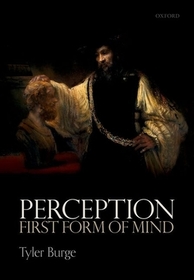
Perception: First Form of Mind
-
10% KEDVEZMÉNY?
- A kedvezmény csak az 'Értesítés a kedvenc témákról' hírlevelünk címzettjeinek rendeléseire érvényes.
- Kiadói listaár GBP 36.99
-
16 700 Ft (15 905 Ft + 5% áfa)
Az ár azért becsült, mert a rendelés pillanatában nem lehet pontosan tudni, hogy a beérkezéskor milyen lesz a forint árfolyama az adott termék eredeti devizájához képest. Ha a forint romlana, kissé többet, ha javulna, kissé kevesebbet kell majd fizetnie.
- Kedvezmény(ek) 10% (cc. 1 670 Ft off)
- Kedvezményes ár 15 030 Ft (14 315 Ft + 5% áfa)
Iratkozzon fel most és részesüljön kedvezőbb árainkból!
Feliratkozom
16 700 Ft

Beszerezhetőség
Megrendelésre a kiadó utánnyomja a könyvet. Rendelhető, de a szokásosnál kicsit lassabban érkezik meg.
Why don't you give exact delivery time?
A beszerzés időigényét az eddigi tapasztalatokra alapozva adjuk meg. Azért becsült, mert a terméket külföldről hozzuk be, így a kiadó kiszolgálásának pillanatnyi gyorsaságától is függ. A megadottnál gyorsabb és lassabb szállítás is elképzelhető, de mindent megteszünk, hogy Ön a lehető leghamarabb jusson hozzá a termékhez.
A termék adatai:
- Kiadó OUP Oxford
- Megjelenés dátuma 2022. május 13.
- ISBN 9780198871019
- Kötéstípus Puhakötés
- Terjedelem898 oldal
- Méret 246x172x43 mm
- Súly 1712 g
- Nyelv angol 203
Kategóriák
Rövid leírás:
Tyler Burge offers an agenda-setting, scientifically rigorous account of the most primitive form of representational mind: perception. He explains how perception works and how it relates to other mental capacities--conation, attention, memory, anticipation, affect, learning, imagining--and clarifies the distinction between perceiving and thinking.
TöbbHosszú leírás:
In Perception: First Form of Mind, Tyler Burge develops an understanding of the most primitive type of mental representational: perception. Focusing on the functions and capacities of perceptual states, Burge accounts for their representational content and structure, and develops a formal semantics for them. The discussion explains the role of iconic format in the structure. It also situates the accounts of content, structure, and semantics within scientific explanations of perceptual-state formation, emphasizing formation of perceptual categorization. In the book's second half, Burge discusses what a perceptual system is. Exploration of relations between perception and other primitive capacities-conation, attention, memory, anticipation, affect, learning, and imagining-helps distinguish perceiving, with its associated capacities, from thinking, with its associated capacities. Drawing mainly on vision science, not introspection, Perception: First Form of Mind is a rigorous, agenda-setting work in philosophy of perception and philosophy of science.
TöbbTartalomjegyzék:
Preface
Part I: Perception
Introduction
Perception
Perceptual Constancy: A Central Psychological Natural Kind
Part II: Form
Some Basics about Perception and Perceptual Systems
Perceptual Reference Requires Perceptual Attribution
Form and Semantics of Perceptual Representational Contents
Perceptual Attributives and Referential Applications in Perceptual Constancies
Egocentric Indexing in Perceptual Spatial and Temporal Frameworks
The Iconic Nature of Perception
Part III: Formation
First-formed Perception
Intra-saccadic Perception and Recurrent Processing
Further Attributives: Primitive Attribution of Causation, Agency
Part IV: System
Perceptual-level Representation and Categorization
Perceptual-level Conation and Relatively Primitive, Perceptually Guided Action
Perceptual Attention
Perceptual Memory I: Shorter Term Systems
Perceptual Memory II: Visual Perceptual Long-Term Memory
Perceptual Learning, Perceptual Anticipation, Perceptual Imagining
Perception and Cognition
Conclusion

