

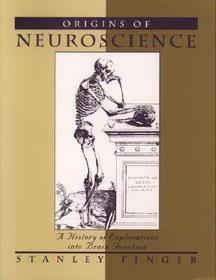
Origins of Neuroscience
A History of Explorations into Brain Function
-
10% KEDVEZMÉNY?
- A kedvezmény csak az 'Értesítés a kedvenc témákról' hírlevelünk címzettjeinek rendeléseire érvényes.
- Kiadói listaár GBP 77.00
-
34 765 Ft (33 110 Ft + 5% áfa)
Az ár azért becsült, mert a rendelés pillanatában nem lehet pontosan tudni, hogy a beérkezéskor milyen lesz a forint árfolyama az adott termék eredeti devizájához képest. Ha a forint romlana, kissé többet, ha javulna, kissé kevesebbet kell majd fizetnie.
- Kedvezmény(ek) 10% (kb. 3 476 Ft)
- Kedvezményes ár 31 289 Ft (29 799 Ft + 5% áfa)
Iratkozzon fel most és részesüljön kedvezőbb árainkból!
Feliratkozom
34 765 Ft

Beszerezhetőség
Megrendelésre a kiadó utánnyomja a könyvet. Rendelhető, de a szokásosnál kicsit lassabban érkezik meg.
Why don't you give exact delivery time?
A beszerzés időigényét az eddigi tapasztalatokra alapozva adjuk meg. Azért becsült, mert a terméket külföldről hozzuk be, így a kiadó kiszolgálásának pillanatnyi gyorsaságától is függ. A megadottnál gyorsabb és lassabb szállítás is elképzelhető, de mindent megteszünk, hogy Ön a lehető leghamarabb jusson hozzá a termékhez.
A termék adatai:
- Kiadás sorszáma New ed
- Kiadó OUP USA
- Megjelenés dátuma 2001. november 1.
- ISBN 9780195146943
- Kötéstípus Puhakötés
- Terjedelem480 oldal
- Méret 216x274x27 mm
- Súly 1143 g
- Nyelv angol
- Illusztrációk frontispiece, halftones and line drawings 0
Kategóriák
Rövid leírás:
An easy-to-read synopsis with over 350 illustrations, this book traces the rich history of ideas about the functioning of the brain from the ancient cultures of Egypt, Greece, and Rome, through the centuries into recent times. Not biographically orientated, this books' emphasis is on the functions of the brain and how they came to be associated with specific brain regions and systems. Very readable, yet detailing the scholarly historical evolution of the field in all its amazing wealth and detail.
This outstanding book is valued as both an historical reference and as an exciting tale of scientific discovery.
Hosszú leírás:
The juxtaposition of historical ideas and brain functions is presented here in a highly readable fashion. The roots of neurology, neuropsychology, and neuroscience are traced, emphasizing the functions of the brain and how they came to be associated with specific brain parts and systems.
Part I is devoted to discussions of science and medicine in the early cultures of Ancient Egypt, Greece, and Rome, as well as an overview of key figures and several landmark events of the Renaissance, the nineteenth, and early twentieth centuries. Part II begins with the sensory systems, starting with vision and audition, working through the skin senses and ending with gustation and olfaction. Part III details the latest advances in motor systems while including the histories of several of the most common movement disorders, like Parkinson's disease, Huntingdon's chorea, and Tourette's syndrome. Part IV examines the history of sleep, dreaming, and the emotions, while the succeeding part discusses higher functions of the brain and the brain as the organ of intellect. Part V also incorporates a discussion of the neurobiology of learning and of several disorders affecting memory.
The final chapters of the book discuss therapies for various brain injuries, and how physicians and scientists began to account for recovery of function, by recognizing factors such as age at the time of injury, which might affect one's response to brain damage.
Students and scholars in the neural sciences, as well as those interested in the history of science and medicine, will find the entire volume useful as a reference for learning about the origins of specific neurological functions or ideas.
`... highly recommended to anyone fascinated by how our brains work.' New Scientist
Tartalomjegyzék:
Part I: Theories of Brain Function
The Brain in Antiquity
Changing Concepts of Brain Function
The Era of Cortical Localization
Holism and the Critics of Cortical Localization
Part II: Sensory Systems
Vision: From Antiquity through the Renaissance
Post-Renaissance Visual Anatomy and Physiology
Color Vision
The Ear and Theories of Hearing
Audition and the Central Nervous System
The Cutaneous Senses
Pain
Gustation
Olfaction
Part III: Motor Functions
The Pyramidal System and the Motor Cortex
The Cerbellum and the Corpus Striatum
Some Movement Disorders
Part IV: Sleep and Function
The Process of Sleep
The Nature of Dreaming
Theories of Emotion from Democritus to William James
Defining and Controlling the Circuits of Emotion
Part V: Intellect and Memory
The Brain and Intellect
The Frontal Lobes and Intellect
The Nature of the Memory Tree
The Neuropathology of Memory
Part VI: Speech and Cerebral Dominance
Speech and Language
The Emergence of the Concept of Cerebral Dominance
The Expansion of the Concept of Cerebral Dominance
Part VII: Treatments, Therapies and Prosthetics
Treatments and Therapies: From Antiquity through the 17th Century
Treatments and Therapies: From 1700 to World War I
Compensatory and Prosthetic Aids
Part VIII: Theories of Recovery
Redundancy and Vicariation Theories
Diaschisis, Shock Effects, and Recovery
Supersensitivity and Recovery
But Is It Recovery?
Part IX: Differing Response to Brain Damage
The Age Factor
Lesion Type and Momentum
Appendix

