

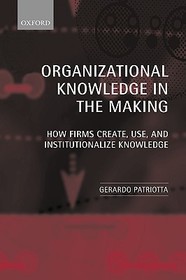
Organizational Knowledge in the Making
How Firms Create, Use, and Institutionalize Knowledge
-
10% KEDVEZMÉNY?
- A kedvezmény csak az 'Értesítés a kedvenc témákról' hírlevelünk címzettjeinek rendeléseire érvényes.
- Kiadói listaár GBP 177.50
-
80 141 Ft (76 325 Ft + 5% áfa)
Az ár azért becsült, mert a rendelés pillanatában nem lehet pontosan tudni, hogy a beérkezéskor milyen lesz a forint árfolyama az adott termék eredeti devizájához képest. Ha a forint romlana, kissé többet, ha javulna, kissé kevesebbet kell majd fizetnie.
- Kedvezmény(ek) 10% (cc. 8 014 Ft off)
- Kedvezményes ár 72 127 Ft (68 693 Ft + 5% áfa)
Iratkozzon fel most és részesüljön kedvezőbb árainkból!
Feliratkozom
80 141 Ft

Beszerezhetőség
Megrendelésre a kiadó utánnyomja a könyvet. Rendelhető, de a szokásosnál kicsit lassabban érkezik meg.
Why don't you give exact delivery time?
A beszerzés időigényét az eddigi tapasztalatokra alapozva adjuk meg. Azért becsült, mert a terméket külföldről hozzuk be, így a kiadó kiszolgálásának pillanatnyi gyorsaságától is függ. A megadottnál gyorsabb és lassabb szállítás is elképzelhető, de mindent megteszünk, hogy Ön a lehető leghamarabb jusson hozzá a termékhez.
A termék adatai:
- Kiadó OUP Oxford
- Megjelenés dátuma 2003. március 27.
- ISBN 9780199256785
- Kötéstípus Keménykötés
- Terjedelem248 oldal
- Méret 242x162x17 mm
- Súly 495 g
- Nyelv angol
- Illusztrációk 11 halftones, numerous line figures 0
Kategóriák
Rövid leírás:
This book deals with the processes by which organizations create, use, and retain knowledge on a day-to-day basis. It provides a critical review of the concepts, debates, and assumptions underpinning existing perspectives on organizational knowledge, and suggests a new vocabulary for understanding knowledge-oriented phenomena in organizations. The book invites scholars, managers, and practitioners to reflect upon the repertoire of knowledge they possess and yet cannot articulate.
TöbbHosszú leírás:
Knowledge is a very seductive, but elusive concept. Following the wider debate about the emergence of the information age and the knowledge society, recent years have seen an explosion of writings about organizational knowledge from different disciplinary and theoretical perspectives. Yet, theoretical development has not always been accompanied by sound empirical research. Methodologies for studying knowledge as an empirical phenomenon are still lagging behind.
This book aims to fill the gap between theory, method, and practice by developing a phenomenological approach to the study of knowing in the context of organizing. The book contributes to the fields of strategy and organization in three ways. First it provides a critical review of the concepts, debates, and epistemological assumptions underpinning existing theories of organizational knowledge. Second, it develops a methodological framework for studying knowledge processes as an empirical phenomenon that is based on three methodological lenses: time, breakdowns, and narratives. Third, drawing on the three-lens framework, the book presents a phenomenological enquiry on knowing and organizing processes within two large car-manufacturing plants at Fiat Auto, Italy. The book highlights the need to re-think organizational knowledge from an action-based perspective and suggests a new vocabulary for understanding knowledge-oriented phenomena in organizations.
The book is addressed both to scholars of strategy and organization and to reflective practitioners. Academics will be stimulated to reflect upon concepts they normally take for granted and habitually use in their research. The book is also suitable for young researchers and doctoral students whose research interests lie in the areas of knowledge and organization. The Fiat case study, on which the book is based, offers interesting insights to practitioners as far as classical themes like change, innovation, and organizational design are concerned. Contrary to mainstream knowledge management texts, however, this book does not provide any recipes about alleged best ways for managing organizational knowledge. Rather, it invites managers and practitioners to reflect about the repertoire of knowledge they possess and yet cannot articulate.
"... entails aggressively novel ideas about the relationships between leading edge technology and empowered staff and, pivotally, about how to make good use of collective learning. But most of all, Patriotta gives us new insight into how to do empirical research in a KM frame."
Tartalomjegyzék:
Part One: Epistemological Foundations
Introduction
Knowing and Organizing
Studying Organizational Knowledge
Part Two: Organizational Knowledge in Action
Tradition and Innovation at Fiat Auto
Knowledge-in-the-Making: The 'Construction' of Fiat Melfi's Factory
Breakdowns and Bottlenecks: Capturing the Learning Dynamics on the Assembly Line
Sense Making on the Shop Floor: The Narrative Dimension of Organizational Knowledge
Part Three: Building a Theory of Knowledge in Organizations
Action, Content, and Time: A Processual Model of Knowing and Organizing
Re-thinking Knowledge in Organizations

