

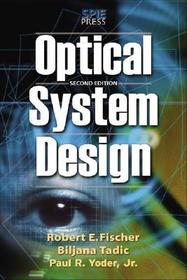
Optical System Design, Second Edition
Sorozatcím: ELECTRONICS;
-
10% KEDVEZMÉNY?
- A kedvezmény csak az 'Értesítés a kedvenc témákról' hírlevelünk címzettjeinek rendeléseire érvényes.
- Kiadói listaár GBP 133.99
-
60 496 Ft (57 615 Ft + 5% áfa)
Az ár azért becsült, mert a rendelés pillanatában nem lehet pontosan tudni, hogy a beérkezéskor milyen lesz a forint árfolyama az adott termék eredeti devizájához képest. Ha a forint romlana, kissé többet, ha javulna, kissé kevesebbet kell majd fizetnie.
- Kedvezmény(ek) 10% (cc. 6 050 Ft off)
- Kedvezményes ár 54 446 Ft (51 854 Ft + 5% áfa)
Iratkozzon fel most és részesüljön kedvezőbb árainkból!
Feliratkozom
60 496 Ft

Beszerezhetőség
Megrendelésre a kiadó utánnyomja a könyvet. Rendelhető, de a szokásosnál kicsit lassabban érkezik meg.
Why don't you give exact delivery time?
A beszerzés időigényét az eddigi tapasztalatokra alapozva adjuk meg. Azért becsült, mert a terméket külföldről hozzuk be, így a kiadó kiszolgálásának pillanatnyi gyorsaságától is függ. A megadottnál gyorsabb és lassabb szállítás is elképzelhető, de mindent megteszünk, hogy Ön a lehető leghamarabb jusson hozzá a termékhez.
A termék adatai:
- Kiadás sorszáma 2
- Kiadó McGraw Hill
- Megjelenés dátuma 2008. március 16.
- ISBN 9780071472487
- Kötéstípus Keménykötés
- Terjedelem809 oldal
- Méret 238x195x45 mm
- Súly 1576 g
- Nyelv angol 0
Kategóriák
Hosszú leírás:
Publisher's Note: Products purchased from Third Party sellers are not guaranteed by the publisher for quality, authenticity, or access to any online entitlements included with the product.
Learn advanced optical design techniques from the field's most respected guide
Honed for more than 20 years in an SPIE professional course taught by renowned optical systems designer Robert E. Fischer, Optical System Design, Second Edition brings you the latest cutting-edge design techniques and more than 400 detailed diagrams that clearly illustrate every major procedure in optical design.
This thoroughly updated resource helps you work better and faster with computer-aided optical design techniques, diffractive optics, and the latest applications, including digital imaging, telecommunications, and machine vision. No need for complex, unnecessary mathematical derivations-instead, you get hundreds of examples that break the techniques down into understandable steps. For twenty-first century optical design without the mystery, the authoritative Optical Systems Design, Second Edition features:
- Computer-aided design use explained through sample problems
- Case studies of third-millennium applications in digital imaging, sensors, lasers, machine vision, and more
- New chapters on optomechanical design, systems analysis, and stray-light suppression
- New chapter on polarization including lots of really useful information
- New and expanded chapter on diffractive optics
- Techniques for getting rid of geometrical aberrations
- Testing, tolerancing, and manufacturing guidance
- Intelligent use of aspheric surfaces in optical design
- Pointers on using off-the-shelf optics
- Basic optical principles and solutions for common and advanced design problems
Publisher's Note: Products purchased from Third Party sellers are not guaranteed by the publisher for quality, authenticity, or access to any online entitlements included with the product.
Learn advanced optical design techniques from the field's most respected guide
Honed for more than 20 years in an SPIE professional course taught by renowned optical systems designer Robert E. Fischer, Optical System Design, Second Edition brings you the latest cutting-edge design techniques and more than 400 detailed diagrams that clearly illustrate every major procedure in optical design.
This thoroughly updated resource helps you work better and faster with computer-aided optical design techniques, diffractive optics, and the latest applications, including digital imaging, telecommunications, and machine vision. No need for complex, unnecessary mathematical derivations-instead, you get hundreds of examples that break the techniques down into understandable steps. For twenty-first century optical design without the mystery, the authoritative Optical Systems Design, Second Edition features:
- Computer-aided design use explained through sample problems
- Case studies of third-millennium applications in digital imaging, sensors, lasers, machine vision, and more
- New chapters on optomechanical design, systems analysis, and stray-light suppression
- New chapter on polarization including lots of really useful information
- New and expanded chapter on diffractive optics
- Techniques for getting rid of geometrical aberrations
- Testing, tolerancing, and manufacturing guidance
- Intelligent use of aspheric surfaces in optical design
- Pointers on using off-the-shelf optics
- Basic optical principles and solutions for common and advanced design problems
Tartalomjegyzék:
Preface
Acknowledgments
Chapter 1: Basic Optics and Optical System Specifications
Chapter 2: Stops and Pupils and Other Basic Principles
Chapter 3: Diffraction, Aberrations, and Image Quality
Chapter 4: The Concept of Optical Path Difference
Chapter 5: Review of Specific Geometrical Aberrations and How to Get Rid of Them
Chapter 6: Glass Selection (including Plastics)
Chapter 7: Spherical and Aspheric Surfaces
Chapter 8: Design Forms
Chapter 9: The Optical Design Process
Chapter 10: Computer Performance Evaluation
Chapter 11. Gaussian Beam Imagery
Chapter 12. Basics of Thermal Infrared Imaging in the 3- to 5- and 8- to 12-um Spectral Bands (Plus UV Optics)
Chapter 13. Diffractive Optics
Chapter 14. Design of Illumination Systems
Chapter 15. Performance Evaluation and Optical Testing
Chapter 16. Tolerancing and Producibility
Chapter 17. Optomechanical Design
Chapter 18. Optical Manufacturing Considerations
Chapter 19. Polarization Issues in Optical Design
Chapter 20. Optical Thin Films
Chapter 21. Hardware Design Issues
Chapter 22. Lens Design Optimization Case Studies
Chapter 23. Optical Sensor Systems Modeling and Analysis
Chapter 24. Stray Light and Optical Scattering
Chapter 25. Bloopers and Blunders in Optics
Chapter 26. Rule of Thumb and Hints
Glossary
Bibliography
Index

