

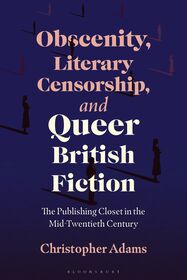
Obscenity, Literary Censorship and Queer British Fiction
The Publishing Closet in the Mid-Twentieth Century
-
18% KEDVEZMÉNY?
- Kiadói listaár GBP 85.00
-
38 377 Ft (36 550 Ft + 5% áfa)
Az ár azért becsült, mert a rendelés pillanatában nem lehet pontosan tudni, hogy a beérkezéskor milyen lesz a forint árfolyama az adott termék eredeti devizájához képest. Ha a forint romlana, kissé többet, ha javulna, kissé kevesebbet kell majd fizetnie.
- Kedvezmény(ek) 18% (kb. 6 907 Ft)
- Kedvezményes ár 31 470 Ft (29 971 Ft + 5% áfa)
- A kedvezmény érvényes eddig: 2026. október 31.
31 470 Ft

Beszerezhetőség
Még nem jelent meg, de rendelhető. A megjelenéstől számított néhány héten belül megérkezik.
Why don't you give exact delivery time?
A beszerzés időigényét az eddigi tapasztalatokra alapozva adjuk meg. Azért becsült, mert a terméket külföldről hozzuk be, így a kiadó kiszolgálásának pillanatnyi gyorsaságától is függ. A megadottnál gyorsabb és lassabb szállítás is elképzelhető, de mindent megteszünk, hogy Ön a lehető leghamarabb jusson hozzá a termékhez.
A termék adatai:
- Kiadó Bloomsbury Publishing (UK)
- Megjelenés dátuma 2026. november 26.
- ISBN 9781350551794
- Kötéstípus Keménykötés
- Terjedelem272 oldal
- Méret 234x156 mm
- Nyelv
- Illusztrációk 6 bw illus 700
Kategóriák
Rövid leírás:
Establishing mid-20th-century queer fiction as both text and book object made up of crucial para-textual elements, this book explores the effect of post-Second World War politics and society on queer novels of the time and the circumstances surrounding their production, marketing and distribution.
TöbbHosszú leírás:
Establishing mid-20th-century queer fiction as both text and book object made up of crucial para-textual elements, this book explores the effect of post-Second World War politics and society on queer novels of the time and the circumstances surrounding their production, marketing and distribution.
In a largely intolerant climate, post-Second World War British publishers issued hundreds of works of fiction featuring queer characters or plotlines; but, against a backdrop of notions of discretion and laws prohibiting homosexuality, both the books and the texts were 'toned down'. Exploring how these products were sites of containment and resistance, and representations of disrupted social, political, and economic conditions of the time, The Publishing Closet calls for us to re-examine and re-define our understandings off mid-century queer fiction and literary culture. With close readings, case studies and analysis of elements such as dust jackets alongside new evidence from the archives of publishing businesses, authors, literary agents, and editors, Christopher Adams covers works by Denton Welch, Francis King, Mary Renault, Martyn Goff and Gore Vidal and events including the accusations of censorship against the retailer W. H. Smith and the obscenity trial of Radcylffe Hall's The Well of Loneliness. Casting fresh light on queer literary history by mapping the confines of the 'publishing closet', this book demonstrates that in viewing queer fiction as book objects we might more fully understand them as products of constricting and competing social, legal, and economic forces that cohered around mid-century conceptions of the queer.
Tartalomjegyzék:
Table of Images
Permissions
Acknowledgements
Abbreviations
Introduction
The Publishing Closet
Chapter One
Writing the Queer Manuscript: Denton Welch and Mid-Century Discretion
Chapter Two
Editing the Queer Manuscript: John Guest and 'Toning Down' in the Works of Francis King and Mary Renault
Chapter Three
Designing and Blurbing the Queer Dust-Jacket
Chapter Four
Marketing the Homosexual Novel: Martyn Goff, Putnam, and Queer Consumers
Chapter Five
Distributing Queer Books: W.H. Smith, Obscenity, and Gore Vidal
Chapter Six
Counterpoint: Publishing the Lesbian Novel
Conclusion
The Future of the Queer Book?

