

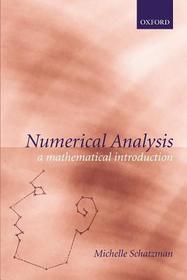
Numerical Analysis
A Mathematical Introduction
-
10% KEDVEZMÉNY?
- A kedvezmény csak az 'Értesítés a kedvenc témákról' hírlevelünk címzettjeinek rendeléseire érvényes.
- Kiadói listaár GBP 60.00
-
27 090 Ft (25 800 Ft + 5% áfa)
Az ár azért becsült, mert a rendelés pillanatában nem lehet pontosan tudni, hogy a beérkezéskor milyen lesz a forint árfolyama az adott termék eredeti devizájához képest. Ha a forint romlana, kissé többet, ha javulna, kissé kevesebbet kell majd fizetnie.
- Kedvezmény(ek) 10% (kb. 2 709 Ft)
- Kedvezményes ár 24 381 Ft (23 220 Ft + 5% áfa)
Iratkozzon fel most és részesüljön kedvezőbb árainkból!
Feliratkozom
27 090 Ft

Beszerezhetőség
Megrendelésre a kiadó utánnyomja a könyvet. Rendelhető, de a szokásosnál kicsit lassabban érkezik meg.
Why don't you give exact delivery time?
A beszerzés időigényét az eddigi tapasztalatokra alapozva adjuk meg. Azért becsült, mert a terméket külföldről hozzuk be, így a kiadó kiszolgálásának pillanatnyi gyorsaságától is függ. A megadottnál gyorsabb és lassabb szállítás is elképzelhető, de mindent megteszünk, hogy Ön a lehető leghamarabb jusson hozzá a termékhez.
A termék adatai:
- Kiadó OUP Oxford
- Megjelenés dátuma 2002. október 24.
- ISBN 9780198508526
- Kötéstípus Puhakötés
- Terjedelem518 oldal
- Méret 235x156x27 mm
- Súly 736 g
- Nyelv angol
- Illusztrációk numerous line drawings 0
Kategóriák
Rövid leírás:
Numerical analysis explains why numerical computations work - or fail. These are mathematical questions, and the book answers in kind, providing students with a very complete and sound presentation of the interface between mathematics and scientific computation. The book does not assume previous knowledge of numerical methods. It includes a large range of exercises, and will be suitable as a textbook at the advanced undergraduate level.
TöbbHosszú leírás:
Numerical analysis explains why numerical computations work, or fail. This book is divided into four parts. Part I starts Part I starts with a guided tour of floating number systems and machine arithmetic. The exponential and the logarithm are constructed from scratch to present a new point of view on questions well-known to the reader, and the needed knowledge of linear algebra is summarized. Part II starts with polynomial approximation (polynomial interpolation, mean-square approximation, splines). It then deals with Fourier series, providing the trigonometric version of least square approximations, and one of the most important numerical algorithms, the fast Fourier transform. Any scientific computation program spends most of its time solving linear systems or approximating the solution of linear systems, even when trying to solve non-linear systems. Part III is therefore about numerical linear algebra, while Part IV treats a selection of non-linear or complex problems: resolution of linear equations and systems, ordinary differential equations, single step and multi-step schemes, and an introduction to partial differential equations. The book has been written having in mind the advanced undergraduate students in mathematics who are interested in the spice and spirit of numerical analysis. The book does not assume previous knowledge of numerical methods. It will also be useful to scientists and engineers wishing to learn what mathematics has to say about the reason why their numerical methods work - or fail.
This is a good mathematics book containing many interesting historical facts and anecdotes. The theorems and proofs are done at a careful level of rigor. This is its strong point.
Tartalomjegyzék:
Part I: The entrance fee
Floating numbers
A flavour of numerical analysis
Algebraic preliminaries
Part II: Polynomial and trigonometric approximation of functions
Interpolation and divided differences
Least squares for polynomials
Splines
Fourier's world
Quadrature
Part III: Numerical linear algebra
Gauss' world
Theoretical interlude
Iterations and recurrences
Pythagoras' world
Part IV: Non-linear problems
Spectra
Non-linear equations and systems
Solving differential systems
Single step schemes
Linear multi-step schemes
Toward partial differential equations
Bibliography
Index

