

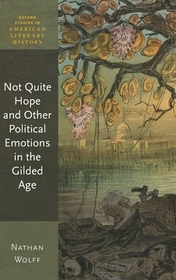
Not Quite Hope and Other Political Emotions in the Gilded Age
Sorozatcím: Oxford Studies in American Literary History;
-
10% KEDVEZMÉNY?
- A kedvezmény csak az 'Értesítés a kedvenc témákról' hírlevelünk címzettjeinek rendeléseire érvényes.
- Kiadói listaár GBP 76.00
-
34 314 Ft (32 680 Ft + 5% áfa)
Az ár azért becsült, mert a rendelés pillanatában nem lehet pontosan tudni, hogy a beérkezéskor milyen lesz a forint árfolyama az adott termék eredeti devizájához képest. Ha a forint romlana, kissé többet, ha javulna, kissé kevesebbet kell majd fizetnie.
- Kedvezmény(ek) 10% (kb. 3 431 Ft)
- Kedvezményes ár 30 883 Ft (29 412 Ft + 5% áfa)
Iratkozzon fel most és részesüljön kedvezőbb árainkból!
Feliratkozom
34 314 Ft

Beszerezhetőség
Megrendelésre a kiadó utánnyomja a könyvet. Rendelhető, de a szokásosnál kicsit lassabban érkezik meg.
Why don't you give exact delivery time?
A beszerzés időigényét az eddigi tapasztalatokra alapozva adjuk meg. Azért becsült, mert a terméket külföldről hozzuk be, így a kiadó kiszolgálásának pillanatnyi gyorsaságától is függ. A megadottnál gyorsabb és lassabb szállítás is elképzelhető, de mindent megteszünk, hogy Ön a lehető leghamarabb jusson hozzá a termékhez.
A termék adatai:
- Kiadó OUP Oxford
- Megjelenés dátuma 2018. december 20.
- ISBN 9780198831693
- Kötéstípus Keménykötés
- Terjedelem240 oldal
- Méret 242x164x22 mm
- Súly 518 g
- Nyelv angol 0
Kategóriák
Rövid leírás:
Focusing on the Washington political novel of the Gilded Age, circa 1869 to 1900, the volume examines the relationship between literature, politics, and democracy, and considers literature's role in defining and exploring the emotional contours of the political landscape in the nineteenth century.
TöbbHosszú leírás:
Not Quite Hope and Other Political Emotions in the Gilded Age argues that late nineteenth-century US fiction grapples with and helps to conceptualize the disagreeable feelings that are both a threat to citizens' agency and an inescapable part of the emotional life of democracy--then as now. In detailing the corruption and venality for which the period remains known, authors including Mark Twain, Harriet Beecher Stowe, Henry Adams, and Helen Hunt Jackson evoked the depressing inefficacy of reform, the lunatic passions of the mob, and the revolting appetites of lobbyists and office seekers. Readers and critics of these Washington novels, historical romances, and satiric romans à clef have denounced these books' fiercely negative tone, seeing it as a sign of cynicism and elitism. Not Quite Hope argues, in contrast, that their distrust of politics is coupled with an intense investment in it: not quite apathy, but not quite hope.
Chapters examine both common and idiosyncratic forms of political emotion, including 'crazy love', disgust, cynicism, 'election fatigue', and the myriad feelings of hatred and suspicion provoked by the figure of the hypocrite. In so doing, the book corrects critics' too-narrow focus on 'sympathy' as the American novel's model political emotion. We think of reform novels as fostering feeling for fellow citizens or for specific causes. This volume argues that Gilded Age fiction refocuses attention on the unstable emotions that continue to shape our relation to politics as such.
Full of splendid insight and erudition, Not Quite Hope and Other Political Emotions in the Gilded Age offers a striking new way to understand the literature of that raucous era. Tracing the negative emotions authors associated with the institutions of American politics, Nathan Wolff shows how disgust, depression, and cynicism can still express an undeclared refusal to passively accept democracy's failings and can become the ground for new political desires and negotiations. Wolff has written a timely and truly accomplished book.
Tartalomjegyzék:
Agitation
Introduction - Bureaucratic Vistas
Madness
Crazy Love: Emotional Insanity in the Gilded Age
Repulsion
Desire, Disgust, Democracy; or, Aversive Attachments
Depression
Strange Apathy: Sentiment and Sovereignty in Ramona
Suspicion
On the Hatred of Hypocrites: Donnelly, Du Bois, Race, and Representation
Cynicism
Cynical Reason in the Cranky Age
Exhaustion
Coda - Election Fatigue: Political Emotion in Space and Time
Notes
Works Cited

