

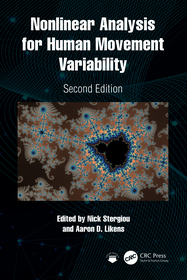
Nonlinear Analysis for Human Movement Variability
-
10% KEDVEZMÉNY?
- Kiadói listaár GBP 103.99
-
46 951 Ft (44 715 Ft + 5% áfa)
Az ár azért becsült, mert a rendelés pillanatában nem lehet pontosan tudni, hogy a beérkezéskor milyen lesz a forint árfolyama az adott termék eredeti devizájához képest. Ha a forint romlana, kissé többet, ha javulna, kissé kevesebbet kell majd fizetnie.
- Kedvezmény(ek) 10% (kb. 4 695 Ft)
- Kedvezményes ár 42 256 Ft (40 244 Ft + 5% áfa)
42 256 Ft

Beszerezhetőség
Még nem jelent meg, de rendelhető. A megjelenéstől számított néhány héten belül megérkezik.
Why don't you give exact delivery time?
A beszerzés időigényét az eddigi tapasztalatokra alapozva adjuk meg. Azért becsült, mert a terméket külföldről hozzuk be, így a kiadó kiszolgálásának pillanatnyi gyorsaságától is függ. A megadottnál gyorsabb és lassabb szállítás is elképzelhető, de mindent megteszünk, hogy Ön a lehető leghamarabb jusson hozzá a termékhez.
A termék adatai:
- Kiadás sorszáma 2
- Kiadó CRC Press
- Megjelenés dátuma 2026. szeptember 23.
- ISBN 9781032495828
- Kötéstípus Keménykötés
- Terjedelem542 oldal
- Méret 234x156 mm
- Súly 453 g
- Nyelv angol
- Illusztrációk 219 Illustrations, black & white; 10 Halftones, black & white; 209 Line drawings, black & white 700
Kategóriák
Rövid leírás:
This book will be an ideal purchase for any student engineer interested in understanding human movement variability including those in the fields of biomedical, industrial, and mechanical engineering.
TöbbHosszú leírás:
Human movement variability can be defined as the typical variations that are present in motor performance and are observed across multiple repetitions of a task. This variability is inherent within all biological systems. It can also be observed easily as it is almost impossible for an individual, even an elite performer, to perform two identical actions of the same task. Nonlinear Analysis for Human Movement Variability, Second edition presents a different approach to studying human movement variability, based on the temporal structure of variability, that is how movement changes over time despite repetitive tasks.
Featuring nine new chapters and numerous case studies, this second edition investigates human movement patterns and how these impact our daily lives. The new edition goes beyond the basics, while maintaining a simple and approachable style and having been fully updated with the latest findings from the research, focusing heavily on methodological developments and inclusion of examples from literature. New topics covered include recurrence quantification analysis, multifractal analysis, fractal correlation and regression, and multiscale probability distribution functions plus much more. New MATLAB code and datasets will accompany each chapter to facilitate teaching and learning. The reader will gather a thorough and detailed analysis and evaluation of how to measure human movement variability.
This book will be an ideal purchase for any student interested in understanding human movement variability including those in fields such as biomechanics and kinesiology, along with students from biomedical, industrial, and mechanical engineering. Its appeal will extend to ergonomists, clinicians, practitioners, and physiologists too.
This title also features PowerPoint slides for instructors to use in their classroom to enhance learning, alongside code and data.
TöbbTartalomjegyzék:
1. Introduction. 2. Time Series. 3. State Space Reconstruction. 4. Lyapunov Exponent. 5. An Introduction to Recurrence Quantification Analysis for Movement Scientists. 6. Surrogation. 7. Autocorrelation Function, Mutual Information, and Correlation Dimension. 8. Movement is Rough and Irregular: An Introduction to Fractal Analysis. 9. Multifractal analysis: A window on the nonlinear release/constraint of degrees of freedom. 10. Multiscale probability density function analysis. 11. Fractal Methods of Association. 12. Measuring Complexity: A Guided Tour of Information Focused Univariate Time Series Methods. 13. Time-Frequency Analysis of Human Movement. 14. Symbolic Regression: A Tool for Discovering Equations of Human Movement Dynamics.
Több
