

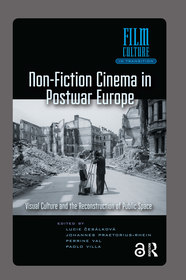
Non-Fiction Cinema in Postwar Europe
Visual Culture and the Reconstruction of Public Space
Sorozatcím: Film Culture in Transition;
-
10% KEDVEZMÉNY?
- Kiadói listaár GBP 47.99
-
21 667 Ft (20 635 Ft + 5% áfa)
Az ár azért becsült, mert a rendelés pillanatában nem lehet pontosan tudni, hogy a beérkezéskor milyen lesz a forint árfolyama az adott termék eredeti devizájához képest. Ha a forint romlana, kissé többet, ha javulna, kissé kevesebbet kell majd fizetnie.
- Kedvezmény(ek) 10% (kb. 2 167 Ft)
- Kedvezményes ár 19 500 Ft (18 572 Ft + 5% áfa)
19 500 Ft

Beszerezhetőség
Megrendelésre a kiadó utánnyomja a könyvet. Rendelhető, de a szokásosnál kicsit lassabban érkezik meg.
Why don't you give exact delivery time?
A beszerzés időigényét az eddigi tapasztalatokra alapozva adjuk meg. Azért becsült, mert a terméket külföldről hozzuk be, így a kiadó kiszolgálásának pillanatnyi gyorsaságától is függ. A megadottnál gyorsabb és lassabb szállítás is elképzelhető, de mindent megteszünk, hogy Ön a lehető leghamarabb jusson hozzá a termékhez.
A termék adatai:
- Kiadás sorszáma 1
- Kiadó Taylor & Francis
- Megjelenés dátuma 2025. december 1.
- ISBN 9781041183624
- Kötéstípus Puhakötés
- Terjedelem518 oldal
- Méret 234x156 mm
- Nyelv angol 752
Kategóriák
Rövid leírás:
After WWII, cinema was everywhere: in movie theatres, public squares, factories, schools, trial courts, trains, museums, and political meetings. This edited volume explores the multiple ways nonfiction cinema reconfigured public spaces, collective participation, democratisation, and governmentality between 1944 and 1956.
TöbbHosszú leírás:
After WWII, cinema was everywhere: in movie theatres, public squares, factories, schools, trial courts, trains, museums, and political meetings. Seen today, documentaries and newsreels, as well as the amateur production, show the kaleidoscopic portrait of a changing Europe. How did these cinematic images contribute to shaping the new societies emerging from the ashes of war, both in the Western and in the Eastern bloc? Why were they so crucial in framing and regulating new places and practices, political systems, economic dynamics, educational frameworks, and memory communities? This edited volume explores the multiple ways nonfiction cinema reconfigured public spaces, collective participation, democratisation, and governmentality between 1944 and 1956. Looking back at it through a transnational perspective and the critical category of spatiality, nonfiction cinema appears in a new light: simultaneously as a specifically situated and as a highly mobile medium, it was a fundamental agent in reshaping Europe’s shared identity and culture in a defining decade.
TöbbTartalomjegyzék:
Preface: (Re)Building Europe Through Cinema (Studies), Section 1 Locating Non-Fiction Film, Section 2 Reconstructing Realities, Section 3 Spaces of Cultural Trauma, Section 4 Creating New Paths, List of Abbreviations, Bibliography, Index
Több
