

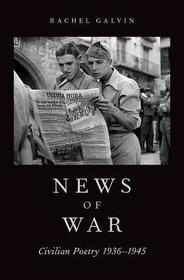
News of War
Civilian Poetry 1936-1945
-
10% KEDVEZMÉNY?
- A kedvezmény csak az 'Értesítés a kedvenc témákról' hírlevelünk címzettjeinek rendeléseire érvényes.
- Kiadói listaár GBP 110.00
-
52 552 Ft (50 050 Ft + 5% áfa)
Az ár azért becsült, mert a rendelés pillanatában nem lehet pontosan tudni, hogy a beérkezéskor milyen lesz a forint árfolyama az adott termék eredeti devizájához képest. Ha a forint romlana, kissé többet, ha javulna, kissé kevesebbet kell majd fizetnie.
- Kedvezmény(ek) 10% (cc. 5 255 Ft off)
- Kedvezményes ár 47 297 Ft (45 045 Ft + 5% áfa)
Iratkozzon fel most és részesüljön kedvezőbb árainkból!
Feliratkozom
52 552 Ft

Beszerezhetőség
Becsült beszerzési idő: A Prosperónál jelenleg nincsen raktáron, de a kiadónál igen. Beszerzés kb. 3-5 hét..
A Prosperónál jelenleg nincsen raktáron.
Why don't you give exact delivery time?
A beszerzés időigényét az eddigi tapasztalatokra alapozva adjuk meg. Azért becsült, mert a terméket külföldről hozzuk be, így a kiadó kiszolgálásának pillanatnyi gyorsaságától is függ. A megadottnál gyorsabb és lassabb szállítás is elképzelhető, de mindent megteszünk, hogy Ön a lehető leghamarabb jusson hozzá a termékhez.
A termék adatai:
- Kiadó OUP USA
- Megjelenés dátuma 2017. november 30.
- ISBN 9780190623920
- Kötéstípus Keménykötés
- Terjedelem384 oldal
- Méret 160x236x33 mm
- Súly 599 g
- Nyelv angol 0
Kategóriák
Rövid leírás:
A new work of scholarship that considers several of the most prominent poets writing from the outbreak of the Spanish Civil War to the end of World War II.
TöbbHosszú leírás:
From the outbreak of the Spanish Civil War until the end of World War II, many poets around the world felt an obligation to write about the wars of their time. Famed poets like Wilfred Owen, Siegfried Sassoon, Isaac Rosenberg, and Ivor Gurney had earned their literary authority because of their experience fighting in the trenches during World War I, but civilian poets who wished to write about warfare doubted their own authority to write about the battles from afar. In News of War, Professor Rachel Galvin argues that this standard is a strongly gendered norm that is problematic for women writers, who were much less likely to have firsthand experience with war. Galvin indicates that the predicament of writing war without witnessing war is exemplified by six of the most prominent poets of the time: a Spanish-language poet, César Vallejo; a French-language poet, Raymond Queneau; and four English-language poets, W. H. Auden, Wallace Stevens, Marianne Moore, and Gertrude Stein.
Although scholars have previously observed the anxieties of civilian poets writing about war, especially in the literature of World War I, Galvin gives the topic a new emphasis by developing the idea that the poets are in dialogue with journalism of the time and developing a framework within which to see their formal patterns for grappling with war at a distance. Expanding on the work of previous scholars who have written on poetry's relation to the news, News of War develops the idea of a strong tendency toward aesthetic self-reflexivity and ethical self-scrutiny in the poetry of the war.
News of War contributes to a growing body of scholarship that seeks to include civilian writing in the canon of twentieth-century war literature...The persuasiveness of Galvin's book, however, is no mere rhetorical trick: it rests on impressive archival work and thorough knowledge of the critical landscape. Her experience as a poet and linguist informs an impressive ability to crack open familiar poems, reading them afresh with compellingly revisionist results.
Tartalomjegyzék:
Acknowledgments
Introduction
Chapter One: Flesh Made Word: César Vallejo and the Spanish Civil War
Chapter Two: W.H. Auden: Rushing to the Pumps, or Not, in Spain and China
Chapter Three: W.H. Auden during World War II
Chapter Four: Wallace Stevens in a “Sudden Time”
Chapter Five: Raymond Queneau, Reading the Poor Paper
Chapter Six: Marianne Moore and the Eyewitness Bind
Chapter Seven: Gertrude Stein and the War She Saw
Epilogue
Works Cited

