

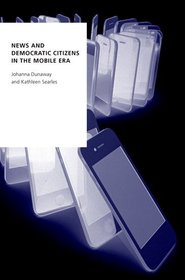
News and Democratic Citizens in the Mobile Era
Sorozatcím: OXFORD STUDIES DIGITAL POLITICS SERIES;
-
10% KEDVEZMÉNY?
- A kedvezmény csak az 'Értesítés a kedvenc témákról' hírlevelünk címzettjeinek rendeléseire érvényes.
- Kiadói listaár GBP 22.49
-
10 744 Ft (10 232 Ft + 5% áfa)
Az ár azért becsült, mert a rendelés pillanatában nem lehet pontosan tudni, hogy a beérkezéskor milyen lesz a forint árfolyama az adott termék eredeti devizájához képest. Ha a forint romlana, kissé többet, ha javulna, kissé kevesebbet kell majd fizetnie.
- Kedvezmény(ek) 10% (cc. 1 074 Ft off)
- Kedvezményes ár 9 669 Ft (9 209 Ft + 5% áfa)
Iratkozzon fel most és részesüljön kedvezőbb árainkból!
Feliratkozom
10 744 Ft

Beszerezhetőség
Becsült beszerzési idő: A Prosperónál jelenleg nincsen raktáron, de a kiadónál igen. Beszerzés kb. 3-5 hét..
A Prosperónál jelenleg nincsen raktáron.
Why don't you give exact delivery time?
A beszerzés időigényét az eddigi tapasztalatokra alapozva adjuk meg. Azért becsült, mert a terméket külföldről hozzuk be, így a kiadó kiszolgálásának pillanatnyi gyorsaságától is függ. A megadottnál gyorsabb és lassabb szállítás is elképzelhető, de mindent megteszünk, hogy Ön a lehető leghamarabb jusson hozzá a termékhez.
A termék adatai:
- Kiadó OUP USA
- Megjelenés dátuma 2022. december 21.
- ISBN 9780190922498
- Kötéstípus Puhakötés
- Terjedelem176 oldal
- Méret 157x237x12 mm
- Súly 268 g
- Nyelv angol 272
Kategóriák
Rövid leírás:
In News and Democratic Citizens in the Mobile Era, Johanna Dunaway and Kathleen Searles demonstrate the effects of mobile devices on news attention, engagement, and recall, and identify a key cognitive mechanism underlying these effects: cognitive effort. They argue that attention and engagement suffer when people consume news on mobile devices, and then investigate the implications of these effects for the news industry and for an informed democratic citizenry. Drawing on both laboratory and real-world studies, Dunaway and Searles bring the psychophysiology of news consumption to bear on the question of what we could lose in an information environment characterized by a dramatic shift in reliance on mobile devices.
TöbbHosszú leírás:
Though people frequently use mobile technologies for news consumption, evidence from several fields shows that smaller screens and slower connection speeds pose major limitations for meaningful reading. In News and Democratic Citizens in the Mobile Era, Johanna Dunaway and Kathleen Searles demonstrate the effects of mobile devices on news attention, engagement, and recall, and identify a key cognitive mechanism underlying these effects: cognitive effort. They advance a theory that is both old and new: the costs of information-seeking curb participatory behaviors unless the benefits outweigh them. For news consumers in the mobile era, for example, mobile devices increase the time, economic, and cognitive costs associated with information-seeking. Only for a small few do the benefits of attending to the news on mobile devices outweigh the costs.
Building on economic theories of news, media choice, and the ways audience demand shapes news craft and production, Dunaway and Searles argue that attention, engagement, and recall suffer when people consume news on mobile devices. They then investigate the implications of these effects for the news industry and for an informed democratic citizenry. Drawing on both laboratory and real-world studies, Dunaway and Searles bring the psychophysiology of news consumption to bear on the question of what we could lose in an information environment characterized by a dramatic shift in reliance on mobile devices.
Dunaway and Searles' new book is a must read for anyone seeking to know how the public understands politics as news consumption increasingly moves to small screens and mobile devices. Drawing on convergent psycho-physiological measures, they find that while there is broader physical access to news, people pay less attention, are less cognitively engaged, and learn less. Their post exposure processing (PEP) theory extends theories of media effects beyond persuasion to reveal the important role that individuals' uses of new technologies are playing in these polarized times.
Tartalomjegyzék:
Chapter 1. Gaining Access and Losing Information
Chapter 2. Post-Exposure Processing: A New Framework and Model
Chapter 3. Mobile Effects on Access and Exposure
Chapter 4. Approaches to Studying Technological Change and Media Effects
Chapter 5. Attention to News on Mobile Devices
(Featuring Mingxiao Sui and Newly Paul)
Chapter 6. Psychophysiological Responses to Mobile News Videos
(Featuring Stuart N. Soroka)
Chapter 7. Learning and Recall on Mobile Devices
Chapter 8. Putting Traffic to the Test: Mobile News Attention in the Wild
Chapter 9. News Exposure and Processing in a Post-Broadcast Environment

